
 Kontakt
 Kako kupovati
Dostava
Savjetnik za kupnju
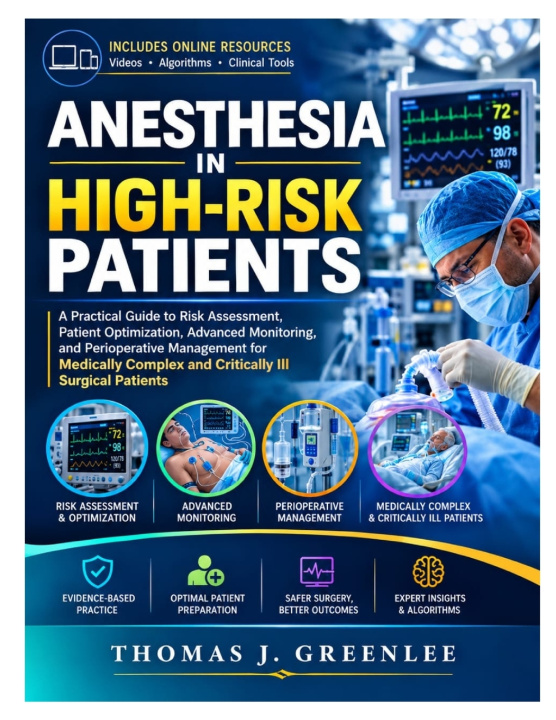
ANESTHESIA IN HIGH-RISK PATIENTS
A Practical Guide to Risk Assessment, Patient Optimization, Advanced Monitoring, and Perioperative Management for Medically Complex and Critically Ill Surgical Patients
 Engleski
 452 b
452 b
 Pripremamo
 Novo
Novo
Do 30 dana za povrat

High-risk anesthesia becomes difficult when the patient cannot afford a predictable mistake.
What changes when your patient has severe cardiovascular disease, impaired lung function, renal or hepatic dysfunction, obesity, frailty, anticoagulation, or several of these problems at once?
You may know the standard anesthetic approach-but still wonder:
What should I assess first?
What can I optimize before surgery?
Which risks matter most?
What should I monitor?
What do I do when the patient's condition suddenly changes?
The answer is not simply "more monitoring" or a longer checklist.
High-risk patients require you to understand how their underlying physiology changes the anesthetic plan-and to anticipate problems before they become emergencies.
Anesthesia in High-Risk Patients provides a clear, practical framework for doing exactly that.
Rather than overwhelming you with complicated theory, it focuses on step-by-step clinical decision-making: assess the patient, identify the major risks, optimize what can be corrected, anticipate complications, choose an appropriate anesthetic strategy, monitor what matters, and respond effectively when the patient's condition changes.
Inside, You'll Learn How To:Perform focused preoperative assessment and risk stratification
Optimize medically complex patients before surgery
Adapt anesthesia to cardiovascular, pulmonary, renal, hepatic, endocrine, and neurologic disease
Approach difficult airways and patients at increased respiratory risk
Manage obesity, sleep apnea, frailty, and advanced age
Evaluate anticoagulation, anemia, bleeding, and transfusion concerns
Choose appropriate hemodynamic and respiratory monitoring
Recognize and respond to major perioperative complications
Approach urgent and emergency surgery when there is little time for optimization
Plan postoperative care for patients who may require critical care
Instead of asking only, "What anesthetic should I give?", learn to ask:
What makes this patient high risk?
What can I optimize?
What could go wrong?
How will I recognize it early?
What will I do if the patient deteriorates?
That shift can make complex cases easier to approach systematically.
No unnecessary complexity.
No one-size-fits-all thinking.
No reliance on memorizing disconnected facts.
Whether you are preparing a medically complex patient for elective surgery or managing an unstable patient who needs urgent intervention, this book gives you a structured way to assess risk, plan care, monitor the patient, and respond to complications.
Ideal For:Anesthesiologists, anesthesia residents and fellows, CRNAs and nurse anesthetists, critical care clinicians, perioperative physicians, surgical residents, and healthcare professionals involved in caring for medically complex and critically ill surgical patients.
The earlier you recognize the risks, the more prepared you are to manage them.
Build a clearer, more confident approach to high-risk anesthesia-starting today.


Informacije o knjizi
Engleski

Poklonite ovu knjigu još danas
To je jednostavno
1 Dodajte knjigu u košaricu i odaberite isporuku kao poklon 2 Zauzvrat ćemo vam poslati kupon 3 Knjiga dolazi na adresu poklonoprimcaDobar dan! Ja sam Libroamiko, vaš književni savjetnik.
Kako vam mogu pomoći?