
 Kontakt
 Kako kupovati
Dostava
Savjetnik za kupnju
 Španjolski
 38 b
38 b
 Novo
Novo
Do 30 dana za povrat

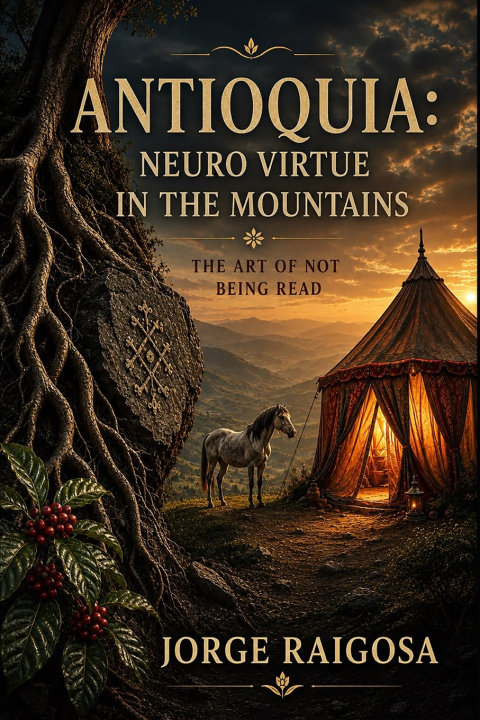
In the open fields of Itagüí - a municipality south of Medellín, Colombia - in the mid-twentieth century, a young man with the surname Raigosa attempted to befriend a Romani girl and found a glass wall. Not hostility: sovereign indifference. That encounter planted a question that took thirty years to become a book. How do you build an identity so complete that the stranger's gaze has no power to disturb you?
Antioquia: Neuro Virtue on the Mountain is the answer. Through seven parts and thirty-one chapters, physician and gerontologist Jorge Raigosa weaves three traditions into a single treatise on mental sovereignty: the epigenetics of Antioquian belonging, the neuroscience of the master rider who governs a paso fino horse, and the millennial survival technology of the Romani people. The result is the first manual of emotional counterintelligence written from the highlands of Colombia for the world - published in the year Medellín becomes the UNESCO World Book Capital 2027.
Extended synopsis
The book develops the concept of Neuro Virtue - defined as the trained capacity of the nervous system to maintain mental sovereignty, the coherence between values, thinking, emotion and action, in the presence of external pressure. Not a moral virtue but a neurological capacity built with the same discipline with which the Antioquian master rider builds the paso fino gait of his horse: years of deliberate practice, coherence between inner state and outward action, and the willingness to be completely oneself even when the environment pressures otherwise.
The book's structure speaks through three figures that carry its argument. The Raigosa name - whose etymology points to the taproot, the deep root that remains in the earth even after the tree has been cut - represents belonging as the foundation of sovereignty. The Antioquian master rider represents the mastery of drive: the practical demonstration that real control is cardiac coherence, reading of micro-signals and the rein operating through imperceptible pressure. The Romani people of Itagüí represent voluntary opacity: the right to be an enigma, to maintain an internal law that no external system can administer.
The seven parts of the book advance from the biological roots of character to the sovereign person's projection toward Medellín 2027. Part I establishes the epigenetic foundation of Antioquian belonging. Part II unpacks the neuroscience of the master rider. Part III narrates the historical and personal encounter with the Romani people in Itagüí. Part IV develops social counterintelligence tactics. Part V applies all those principles to enterprise and negotiation. Part VI delivers the practical fortress maintenance manual. And Part VII projects individual sovereignty toward the collective legacy of a city that has chosen the written word as its instrument of transformation.
A book for the leader seeking to lead with serenity, for the equestrian seeking to deepen the connection with their horse, for anyone from any of Antioquia's 123 municipalities who wants to understand the character their land formed - and above all for anyone who has ever wished to be the unambiguous author of their own narrative rather than a character in someone else's.
Includes section 11.6 - The Counterfactual - in which the author asks aloud for the first time: What would have happened if the Romani girl had yielded? The answer is the most honest moment in the book and the core of its entire argument.


Informacije o knjizi
Španjolski

Poklonite ovu knjigu još danas
To je jednostavno
1 Dodajte knjigu u košaricu i odaberite isporuku kao poklon 2 Zauzvrat ćemo vam poslati kupon 3 Knjiga dolazi na adresu poklonoprimcaDobar dan! Ja sam Libroamiko, vaš književni savjetnik.
Kako vam mogu pomoći?