
 Kontakt
 Kako kupovati
Dostava
Savjetnik za kupnju
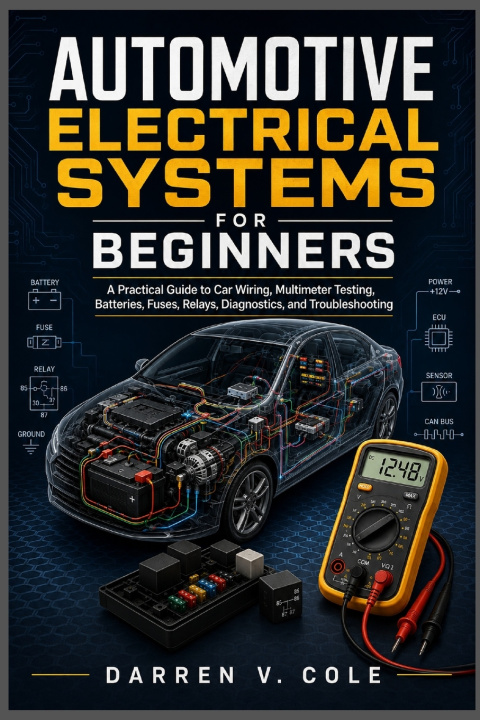
AUTOMOTIVE ELECTRICAL SYSTEMS FOR BEGINNERS
A Practical Guide to Car Wiring, Multimeter Testing, Batteries, Fuses, Relays, Diagnostics, and Troubleshooting
 Engleski
 49 b
49 b
 Novo
Novo
Do 30 dana za povrat

What if the electrical problem frustrating you could be diagnosed logically instead of turning into a costly guessing game?
A vehicle can have a healthy engine and still refuse to start. A single loose connection can create multiple warning lights. A weak ground can make an accessory behave unpredictably. A blown fuse can be a symptom rather than the real problem. The challenge is that modern vehicles combine batteries, wiring, relays, sensors, control modules, communication networks, and electronic systems into increasingly connected circuits. Without knowing how those systems interact or how to test them correctly, it is easy to replace good parts, overlook simple faults, or spend money without getting closer to the real cause.
This book takes a different approach. Rather than giving you a collection of isolated fixes to memorize, it teaches you how to think through an electrical problem from symptom to cause. You will build your understanding progressively, starting with fundamental electrical concepts and moving into practical testing, circuit interpretation, major vehicle systems, electronic diagnostics, and systematic troubleshooting. The unique strength of this guide is its emphasis on testing before replacing. You learn not only what a component does, but how to determine whether it is actually responsible for the fault.
Using clear explanations, practical examples, diagnostic sequences, and strategically designed visual references, you will learn how to follow a circuit, identify missing power or ground, recognize excessive resistance, interpret measurements, use diagnostic codes intelligently, and confirm that a repair has genuinely solved the original problem.
Inside, you'll discover how to:
Understand voltage, current, resistance, power, circuits, and electrical flow
Identify the purpose of batteries, fuses, relays, switches, grounds, connectors, sensors, and actuators
Use a digital multimeter for voltage, resistance, continuity, and practical circuit testing
Read basic wiring diagrams and trace power and ground paths
Diagnose starting and charging system problems systematically
Troubleshoot headlights, interior lighting, windows, locks, wipers, horns, and other accessories
Recognize electrical problems affecting ignition, fuel delivery, and engine-control systems
Interpret OBD-II diagnostic trouble codes without automatically replacing the associated component
Understand the basic principles behind CAN bus communication and modern vehicle networks
Identify voltage drop, poor grounds, corrosion, damaged wiring, excessive resistance, and intermittent faults
Work through realistic diagnostic examples using a repeatable troubleshooting process
Avoid common mistakes that lead to unnecessary parts replacement and wasted time
Document findings and use test results to guide the next diagnostic step
Verify repairs instead of assuming the problem is fixed
Whether you are a complete beginner, a DIY car enthusiast, an automotive student, or someone who simply wants to understand what is happening when a vehicle develops an electrical fault, this guide gives you a practical foundation without overwhelming you with unnecessary complexity.
You do not need to memorize hundreds of repairs. You need to understand the circuit, ask the right questions, perform the right tests, and let the evidence guide you.
Stop guessing. Start testing. Build practical diagnostic confidence and turn confusing electrical symptoms into problems you can approach systematically. Get your copy today and start developing skills you can use on real vehicles.


Informacije o knjizi
Engleski
