
 Kontakt
 Kako kupovati
Dostava
Savjetnik za kupnju
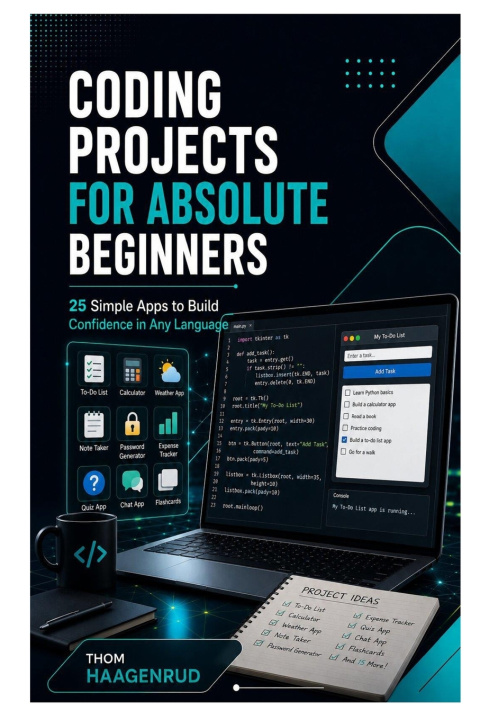
Coding Projects for Absolute Beginners
25 Simple Apps to Build Confidence in Any Language
 Engleski
 44 b
44 b
 Pripremamo
 Novo
Novo
Do 30 dana za povrat

Do you want to move beyond basic syntax and finally build small programs you can actually finish, test, and explain?
Coding Projects for Absolute Beginners is a practical, beginner-friendly guide to building 25 simple applications that develop real programming confidence. Written for complete beginners, students, career switchers, self-taught learners, working professionals, and readers who understand fragments of code but struggle to assemble them into finished programs, this book teaches programming through small, complete, understandable projects.
Instead of asking you to memorize isolated commands, this book teaches you how to plan a program, define inputs and outputs, write pseudocode, build a minimum working version, test normal and unusual cases, fix mistakes systematically, and improve one feature at a time.
Python is used for the reference implementations because its readable syntax keeps attention on program logic. However, the projects are designed to be language-neutral. You can complete them in Python, JavaScript, Java, C#, Ruby, or another general-purpose language by following the project specifications, pseudocode, test cases, and translation guidance.
The learning path is deliberately cumulative. The first chapters teach planning and workspace setup. The early projects develop arithmetic, conversion, text handling, decisions, validation, loops, and repetition. Later projects introduce collections, records, state, randomness, timers, files, search, sorting, structured data, logs, APIs, and external information.
Every project follows a consistent structure: objective, concepts practised, inputs, outputs, rules, constraints, pseudocode, implementation steps, test cases, common mistakes, troubleshooting, and extension ideas. This repetition is intentional. A dependable process is more useful than a collection of disconnected examples.
The book also teaches habits that help beginners become independent. You will learn to finish the minimum version before expanding, test normal and boundary cases, keep working checkpoints, read errors completely, diagnose one cause at a time, document decisions, and explain your own code clearly.
Part V removes much of the scaffolding and guides you through designing your own capstone project. You will define the problem, choose features, design data, write pseudocode, plan implementation milestones, test behavior, refactor safely, document the result, and prepare the project for presentation.
No previous professional experience is required. The book does not assume advanced mathematics, algorithms, databases, frameworks, object-oriented design, version control, or prior work with web services. You should be willing to type code, run programs, inspect errors, test results, and improve your solutions through practice.
Whether you are completely new to programming, returning after unfinished tutorials, preparing for a first coding course, learning a second language, building practical office tools, or developing confidence for larger programming books, this guide gives you a structured route from small ideas to finished applications.
Stop collecting syntax fragments without building anything complete. Learn how to plan, code, test, debug, refactor, port, package, and present small programming projects with confidence.


Informacije o knjizi
Engleski

Poklonite ovu knjigu još danas
To je jednostavno
1 Dodajte knjigu u košaricu i odaberite isporuku kao poklon 2 Zauzvrat ćemo vam poslati kupon 3 Knjiga dolazi na adresu poklonoprimcaDobar dan! Ja sam Libroamiko, vaš književni savjetnik.
Kako vam mogu pomoći?