
 Kontakt
 Kako kupovati
Dostava
Savjetnik za kupnju
 Engleski
 50 b
50 b
 Novo
Novo
Do 30 dana za povrat

Synopsis
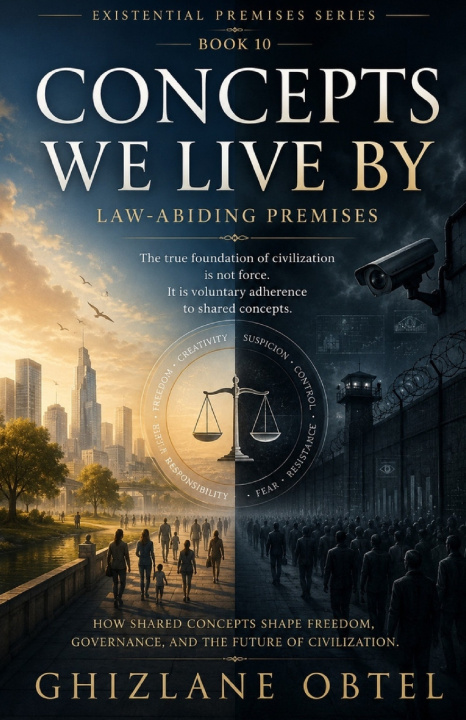
Concepts We Live By offers a philosophical analysis of how civilizations are structured and sustained not primarily through force or formal institutions, but through the voluntary embodiment of shared concepts. It investigates why millions of strangers obey laws they did not personally create and argues that the answer lies in the invisible conceptual agreements that underpin collective life.
The book begins by examining the architecture of society through constitutions, laws, policies, and norms, showing that these are not merely external constraints but expressions of deeper existential premises. Constitutions function as foundational civilizational agreements, laws operationalize abstract moral and social concepts into behavior, and policies translate collective intentions into directional governance. Beneath all of these lies an invisible conceptual infrastructure that makes coordinated human life possible.
Building on this foundation, the work develops a central distinction between voluntary law-abidance and coercive enforcement. It argues that when citizens internalize shared concepts such as responsibility, fairness, and legitimacy, laws become self-sustaining. In such conditions, governance requires less surveillance and enforcement, allowing both citizens and institutions to expand their social agency toward creation, innovation, and long-term development. Conversely, when conceptual alignment weakens, the state must increasingly rely on monitoring, policing, and coercion to maintain order.
The book introduces two interlocking feedback structures: the virtuous cycle of freedom and the vicious cycle of coercion. In the virtuous cycle, trust generates stability, stability produces prosperity, prosperity enables innovation, and innovation reinforces trust, creating an upward spiral of civilizational expansion. In the vicious cycle, distrust leads to monitoring, monitoring leads to enforcement, enforcement generates resistance, and resistance further deepens distrust, creating a downward spiral of increasing control and declining creative capacity.
From these dynamics emerges a broader civilizational theory centered on energy allocation. Societies are understood as systems that direct collective energy either outward-toward discovery, invention, and progress-or inward-toward surveillance, enforcement, and control. The direction of this energy determines whether a civilization expands its possibilities or becomes increasingly absorbed in managing internal instability.
The analysis culminates in the identification of two archetypal civilizational forms. The Expanding Society is characterized by high trust, voluntary compliance, low surveillance, and broad social and governance agency directed toward creation and innovation. The Contracting Society is characterized by low trust, intensive monitoring, coercive enforcement, and a growing internal focus on control rather than development. These archetypes are not static categories but dynamic tendencies shaped by the degree of voluntary conceptual embodiment within a population.
Ultimately, the book argues that civilizations are not primarily governed by laws in themselves, but by the extent to which citizens freely live the concepts that give those laws meaning. When this embodiment is strong, freedom expands and coercion recedes. When it weakens, coercion expands and freedom contracts. Civilization, therefore, is understood as a continuous movement between these two poles.
In conclusion, the true foundation of free societies is not force, but shared concepts that are voluntarily lived. Laws, institutions, and governments are expressions of this deeper reality, not its origin. In this view, the history of civilization is the ongoing negotiation between internalized order and externally imposed control, determining whether human societies evolve toward expanding possibility or increasing constraint.<...


Informacije o knjizi
Engleski
Kategorija

Poklonite ovu knjigu još danas
To je jednostavno
1 Dodajte knjigu u košaricu i odaberite isporuku kao poklon 2 Zauzvrat ćemo vam poslati kupon 3 Knjiga dolazi na adresu poklonoprimcaDobar dan! Ja sam Libroamiko, vaš književni savjetnik.
Kako vam mogu pomoći?