
 Kontakt
 Kako kupovati
Dostava
Savjetnik za kupnju
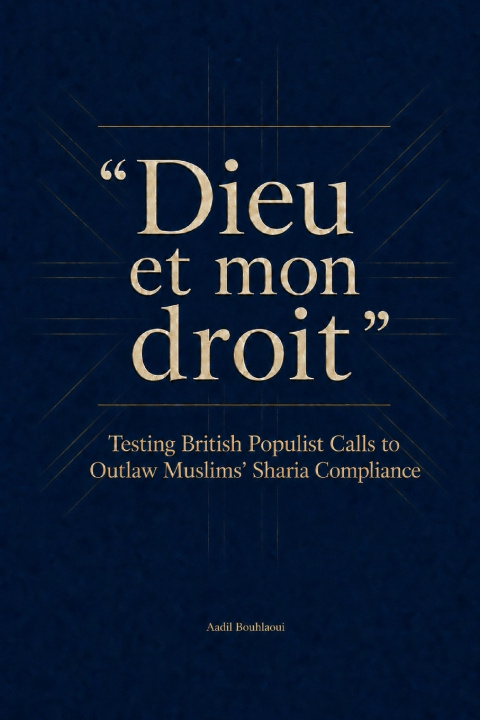
"Dieu et mon droit"
Testing British Populist Calls to Outlaw Muslims' Sharia Compliance
 Engleski
 18 b
18 b
 Novo
Novo
Do 30 dana za povrat

This research examines the dilemma created by populist representations of Sharia in some Western democracies, with a primary focus on the United Kingdom. The central question is not theological. It is political and legal: when populist actors invoke "Sharia" as proof that Islam is incompatible with liberal-democratic order, what precisely are they describing, who is actually practicing what is called "Sharia compliance," what legal force does it possess, and what would follow from attempts to ban or suppress it? The paper argues that in Britain the term "Sharia" operates simultaneously as a symbol in political rhetoric and as a label for a wide variety of ordinary social practices, many of which are already accommodated within general law: dietary rules, modest dress, charitable giving, marriage choices, religious divorce, funeral practices, inheritance planning, commercial ethics, and faith-sensitive finance. The paper further argues that this field is neither empty nor innocuous. Real problems exist: unregistered religious marriages, discriminatory advice, coercive social pressure, domestic abuse, misinformation about civil rights, and the informal authority of religious intermediaries. Yet the evidence does not support the thesis that England and Wales contain a parallel sovereign legal system capable of imposing Islamic law on unwilling non-Muslims or of displacing the supremacy of Parliament and the ordinary courts.
The British case shows a more complicated reality. On 30 June 2026, the Ministry of Justice again stated that there are no Sharia courts in England or Wales. Sharia councils have no standing as state courts and no independent coercive jurisdiction under civil law. They may advise, mediate, or assist with religious divorce, and in rare cases some disputes may be arbitrated by consent under the Arbitration Act, but family status, child welfare, domestic abuse, criminal matters, and enforceable public law remain governed by the state. The paper therefore distinguishes between private religious compliance, legally recognised private ordering, and coercive or discriminatory conduct. That distinction matters because a politics that collapses all three into one undifferentiated threat produces bad law and bad social outcomes.
The paper then broadens the comparison. Imperial Britain in India and colonial France in Algeria both administered versions of Muslim personal status law, not because they were weak or indifferent states, but because legal pluralism was historically one of the ordinary techniques of rule. Non-Muslim-majority states today, including Russia and China, permit some Muslim practice while constraining or controlling it under state supremacy. Muslim-majority countries themselves commonly accommodate non-Muslim personal law in family and inheritance matters. Israel, despite its intense security conflict with Islamist movements, still maintains a legal framework in which Sharia courts operate in personal status matters and, since 24 March 2026, may arbitrate certain civil matters by consent under newly approved legislation. The contemporary UAE offers another model: Sharia-based personal status for Muslims, with civil personal status options for non-Muslims. Morocco recognizes Jewish personal status institutions, while Egypt continues to develop separate Muslim and Christian personal status legislation.
The paper concludes that blanket anti-Sharia legislation in Britain would be overbroad, difficult to define coherently, and counterproductive. It would threaten ordinary religious freedoms, drive some disputes underground, make some Muslim women more vulnerable rather than less, and impose avoidable costs on non-Muslim and Muslim businesses alike in areas such as halal supply chains and Islamic finance.


Informacije o knjizi
Engleski
Kategorija

Poklonite ovu knjigu još danas
To je jednostavno
1 Dodajte knjigu u košaricu i odaberite isporuku kao poklon 2 Zauzvrat ćemo vam poslati kupon 3 Knjiga dolazi na adresu poklonoprimcaDobar dan! Ja sam Libroamiko, vaš književni savjetnik.
Kako vam mogu pomoći?