
 Kontakt
 Kako kupovati
Dostava
Savjetnik za kupnju
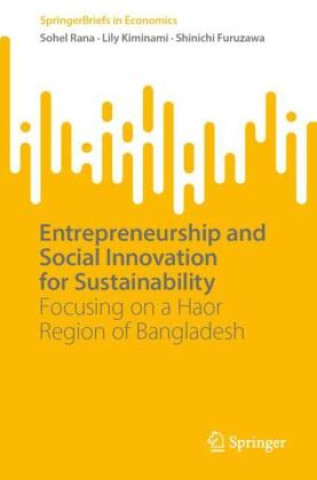
Entrepreneurship and Social Innovation for Sustainability
Focusing on a Haor Region of Bangladesh
 Engleski
 125 b
125 b
Do 30 dana za povrat
Kupci su kupili i










 /
/
 Meki uvez
 5.11
€
5.11
€




 /
Meki uvez
12.04
€
/
Meki uvez
12.04
€

This book aims to assess the roles of entrepreneurship and social innovation for socio-cultural changes. It also evaluates farmers' performance in disaster risk management at a community level toward sustainable regional development in a rural haor region of Bangladesh. To achieve the purpose of the research, both a qualitative method (Trajectory Equifinality Modeling, TEM) and a quantitative method (Structural Equation Modeling, SEM) are introduced, based on the results of case studies on local entrepreneurs, interview and focus group discussions with stakeholders, and questionnaire surveys of farm households.First, the results clarify that social capital is critically important both for male and female entrepreneurs in the haor region, and that education is more important to women for empowerment and technology adoption in the entrepreneurial ecosystem in the haor region of Bangladesh. In addition, it makes clear that the Common Interest Group approach plays a role for women's empowerment in the target region. Furthermore, it identifies the multi-causal relationships among the factors affecting farm households' performance in disaster risk management at the community level.This book helps readers to understand regional development through social and cultural transformation in a rural community where poverty and gender discrimination are path-dependent problems.


Informacije o knjizi
Engleski

Poklonite ovu knjigu još danas
To je jednostavno
1 Dodajte knjigu u košaricu i odaberite isporuku kao poklon 2 Zauzvrat ćemo vam poslati kupon 3 Knjiga dolazi na adresu poklonoprimcaMoglo bi vas zanimati i
 /
Tvrdi uvez
116.11
€
/
Tvrdi uvez
116.11
€






















 /
Tvrdi uvez
220.48
€
/
Tvrdi uvez
220.48
€
Dobar dan! Ja sam Libroamiko, vaš književni savjetnik.
Kako vam mogu pomoći?