Kontakt
 Kako kupovati
Dostava
Savjetnik za kupnju
 Engleski
 125 b
125 b
Do 30 dana za povrat
Kupci su kupili i

















 /
/
 Meki uvez
 9.47
€
9.47
€

 /
Meki uvez
16.54
€
/
Meki uvez
16.54
€




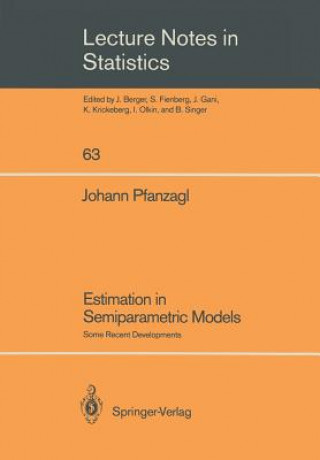
Assume one has to estimate the mean J x P( dx) (or the median of P, or any other functional t;;(P)) on the basis ofi.i.d. observations from P. Ifnothing is known about P, then the sample mean is certainly the best estimator one can think of. If P is known to be the member of a certain parametric family, say {Po: {) E e}, one can usually do better by estimating {) first, say by {)(n)(.~.), and using J XPo(n)(;r.) (dx) as an estimate for J xPo(dx). There is an "intermediate" range, where we know something about the unknown probability measure P, but less than parametric theory takes for granted. Practical problems have always led statisticians to invent estimators for such intermediate models, but it usually remained open whether these estimators are nearly optimal or not. There was one exception: The case of "adaptivity", where a "nonparametric" estimate exists which is asymptotically optimal for any parametric submodel. The standard (and for a long time only) example of such a fortunate situation was the estimation of the center of symmetry for a distribution of unknown shape.


Informacije o knjizi
Engleski