
 Kontakt
 Kako kupovati
Dostava
Savjetnik za kupnju
 Engleski
 47 b
47 b
 Novo
Novo
Do 30 dana za povrat

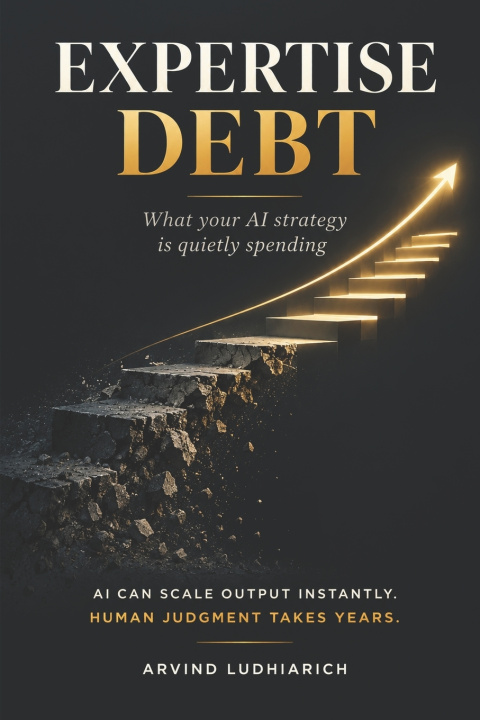
AI is making organizations more productive. It may also be quietly consuming the expertise they will need to survive what comes next.
Companies are measuring what AI produces: faster analysis, lower costs, higher output, shorter cycle times.
Almost nobody is measuring what it removes.
When AI takes over the work through which junior professionals once learned judgment, made mistakes, built mental models, and became senior experts, organizations create a hidden liability: Expertise Debt.
In this book, Arvind Ludhiarich examines a problem most AI strategies overlook: What happens to the human expertise required to supervise AI when AI is increasingly doing the work through which that expertise used to be built?
Drawing on research in artificial intelligence, learning science, software engineering, aviation, automation, and organizational design, Expertise Debt shows why:
- AI-assisted performance and human capability are no longer the same thing.
- Automation can remove the productive struggle through which expertise develops.
- "Human in the loop" governance fails if the human gradually loses the expertise required to challenge the machine.
- Organizations can improve today's productivity while weakening tomorrow's decision-making capacity.
- The risk is difficult to see because traditional KPIs measure output, not the regeneration of human judgment.
The book introduces Expertise Debt as a management concept and Cognitive Capital as the asset organizations must deliberately build and protect.
It also provides practical tools for executives, including a self-assessment, Cognitive Impact Assessment, management indicators, a scorecard, and board-level questions for evaluating AI initiatives.
This is not an argument against AI.
It is an argument for managing AI with a variable most organizations have forgotten to measure:
the human capability that must remain when the machine is wrong.


Informacije o knjizi
Engleski

Poklonite ovu knjigu još danas
To je jednostavno
1 Dodajte knjigu u košaricu i odaberite isporuku kao poklon 2 Zauzvrat ćemo vam poslati kupon 3 Knjiga dolazi na adresu poklonoprimcaDobar dan! Ja sam Libroamiko, vaš književni savjetnik.
Kako vam mogu pomoći?