
 Kontakt
 Kako kupovati
Dostava
Savjetnik za kupnju
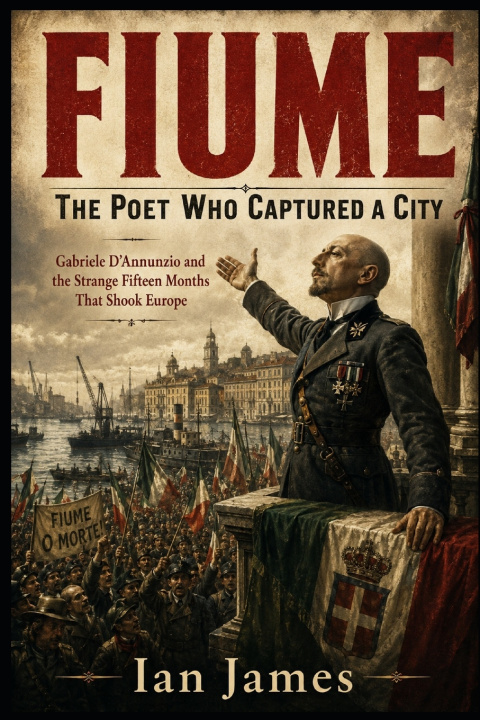
Fiume
The Poet Who Captured a City: Gabriele D'Annunzio and the Strange Fifteen Months That Shook Europe
 Engleski
 30 b
30 b
 Pripremamo
 Novo
Novo
Do 30 dana za povrat

Fiume: The Poet Who Captured a City
In September 1919, Italian poet, war hero, and political provocateur Gabriele D'Annunzio did something almost unbelievable.
He gathered thousands of soldiers and veterans, defied the Italian government, marched into the disputed Adriatic city of Fiume, and took control without a conventional battle.
What followed was one of the strangest political experiments to emerge from the ruins of the First World War.
For fifteen extraordinary months, Fiume became part military occupation, part revolutionary state, part nationalist spectacle, and part political laboratory. D'Annunzio ruled as the charismatic Comandante, addressing crowds from balconies while soldiers, aviators, syndicalists, artists, adventurers, and political radicals poured into the city.
Ships were seized to obtain supplies. Legionaries paraded through the streets. Political ceremonies mixed with music, uniforms, slogans, and Roman symbolism. Then D'Annunzio and revolutionary syndicalist Alceste De Ambris produced the remarkable Charter of Carnaro, a constitution combining nationalism, labor organization, civil rights, political experimentation, and D'Annunzio's extraordinary belief that even music should occupy a central place in public life.
But Fiume could not remain outside normal politics forever.
The Italian government lost patience. A diplomatic settlement created the Free State of Fiume, but D'Annunzio refused to accept it. In December 1920, Italian troops moved against the city.
The confrontation became known as Bloody Christmas.
Italian soldiers fought Italian legionaries. Warships opened fire. The poet who had captured a city through charisma and defiance finally discovered the limits of political theatre.
Yet the influence of Fiume did not end with D'Annunzio's defeat.
Benito Mussolini watched closely.
The mass rallies, uniforms, balcony speeches, chants, Roman imagery, veteran politics, and cult of charismatic leadership seen at Fiume would later appear in far more powerful-and far more dangerous-forms during the rise of Italian Fascism.
But was Fiume truly the birthplace of Fascism?
The answer is far more complicated.
Fiume: The Poet Who Captured a City tells the remarkable true story of a poet who became a commander, a disputed port that became a revolutionary state, and fifteen turbulent months that offered Europe an early glimpse of the political forces that would shape the decades ahead.
Written as a fast-moving narrative rather than a dry academic history, this book explores:
- Gabriele D'Annunzio's transformation from celebrated poet to wartime hero
- Italy's anger over the so-called "Mutilated Victory"
- The bitter international struggle over Fiume
- D'Annunzio's extraordinary September 1919 march on the city
- The Arditi, legionaries, aviators, revolutionaries, and adventurers who joined him
- Piracy, smuggling, seized ships, and life inside the rebel city
- The unusual Charter of Carnaro
- D'Annunzio's complicated relationship with Benito Mussolini
- The Treaty of Rapallo and the creation of the Free State of Fiume
- The dramatic fighting of Bloody Christmas
- The occupation's controversial legacy and its connection to the rise of Fascism
For readers interested in World War I, interwar Europe, Italian history, Fascism, political revolutions, military history, and forgotten episodes of twentieth-century history, Fiume: The Poet Who Captured a City reveals one of the strangest stories to emerge from the aftermath of the Great War.
A poet. An army of veterans. A city nobody could agree on. And fifteen months that helped change European politics forever.


Informacije o knjizi
Engleski

Poklonite ovu knjigu još danas
To je jednostavno
1 Dodajte knjigu u košaricu i odaberite isporuku kao poklon 2 Zauzvrat ćemo vam poslati kupon 3 Knjiga dolazi na adresu poklonoprimcaDobar dan! Ja sam Libroamiko, vaš književni savjetnik.
Kako vam mogu pomoći?