
 Kontakt
 Kako kupovati
Dostava
Savjetnik za kupnju
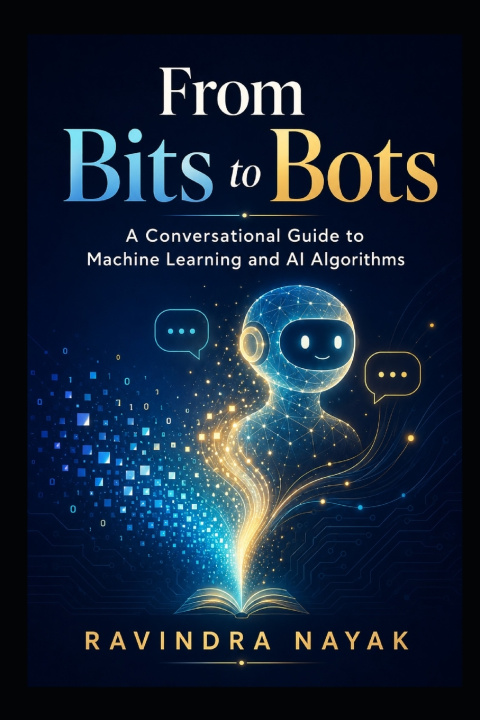
"From Bits to Bots
A Conversational Guide to Machine Learning and AI Algorithms"
 Engleski
 47 b
47 b
Do 30 dana za povrat

What if machine learning stopped feeling like a wall of formulas and started making sense as a human story about evidence, patterns, choices, and consequences?
From Bits to Bots is a calm, conversational guide for readers who want to understand artificial intelligence and machine learning without being pushed immediately into code or intimidating mathematics. Through Emma Learner's questions, Dr. Alan Mentor's first-principles explanations, Professor Lexicon's language lessons, memorable scenes, visual maps, and practical reflection, complex ideas become clear one layer at a time.
The journey begins before the algorithms. You will see how the world becomes data, how features describe examples, how labels define the answer a model is asked to learn, and why a prediction is a responsible estimate rather than a promise. From there, the book opens the major families of machine learning in plain language: K-nearest neighbors, Naive Bayes, linear and logistic regression, support vector machines, decision trees, bagging, random forests, boosting, neural networks, convolutional networks, recurrent networks, LSTMs, time-series forecasting, ARIMA, clustering, dimensionality reduction, and model fusion.
But understanding an algorithm is only part of understanding AI. The later parts follow the full path from prototype to practice: pipelines, feature engineering, experiment design, hyperparameters, model evaluation, fairness, explanation, human review, deployment, monitoring, drift, recovery, and communication. The book continually asks the questions that matter outside a demonstration: What evidence shaped the model? What kind of error is costly? Who is affected? When should a person review the result? What happens when reality changes?
The final Value Edition turns reading into lasting knowledge. It helps you rebuild the entire journey from first principles, reduce fear of mathematics, divide difficult problems into manageable chunks, strengthen recall, diagnose mistakes, brainstorm use cases, and develop the confidence to ask better questions about AI systems.
No programming background is required. This book is designed for curious beginners, students, professionals, managers, founders, educators, decision-makers, and anyone who uses AI but wants a clearer view of what lies beneath the interface.
You will not finish with a collection of impressive terms. You will finish with a mental map: data becomes representation, representation supports learning, learning produces an estimate, an estimate enters a human decision, and the consequences return as new evidence. That map will help you understand the technology, judge its claims more carefully, and participate in conversations about AI with greater clarity and responsibility.


Informacije o knjizi
Engleski

Poklonite ovu knjigu još danas
To je jednostavno
1 Dodajte knjigu u košaricu i odaberite isporuku kao poklon 2 Zauzvrat ćemo vam poslati kupon 3 Knjiga dolazi na adresu poklonoprimcaDobar dan! Ja sam Libroamiko, vaš književni savjetnik.
Kako vam mogu pomoći?