Kontakt
 Kako kupovati
Dostava
Savjetnik za kupnju
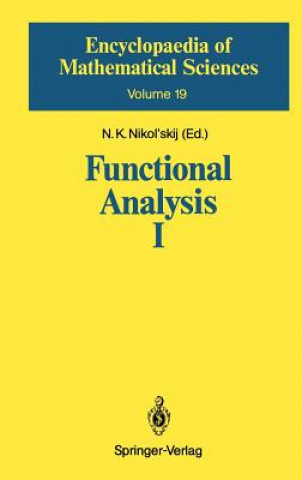
Functional Analysis I
 Engleski
 299 b
299 b
Do 30 dana za povrat
Kupci su kupili i

 /
/
 Meki uvez
 25.99
€
25.99
€





The twentieth century view of the analysis of functions is dominated by the study of classes of functions, as contrasted with the older emphasis on the study of individual functions. Operator theory has had a similar evolution, leading to a primary role for families of operators. This volume of the Encyclopaedia covers the origins, development and applications of linear functional analysis, explaining along the way how one is led naturally to the modern approach. The book consists of two chapters, the first of which deals with classical aspects of the subject, while the second presents the abstract modern theory and some of its applications. Both chapters are divided into sections which are devoted to individual topics. For each topic the origins are traced, the principal definitions and results are stated and illustrative examples for theory and applications are given. Usually proofs are omitted, although certain sections of Chapter 2 do contain some quite detailed proofs. §The classical concrete problems of Chapter 1 provide motivation and examples, as well as a technical foundation, for the theory in Chapter 2. §EMS 19 ist der einzige EMS-Band in Funktionalanalysis, der in absehbarer Zeit erscheinen wird. Er gibt einen Überblick über das Gebiet, wobei er sowohl den klassischen Zugang als auch den modernen Zugang abdeckt. Durch den weitverbreiteten Gebrauch der Funktionalanalysis in anderen Gebieten der Mathematik ergänzt dieser Band die anderen vier EMS-Unterreihen in Analysis.The twentieth century view of the analysis of functions is dominated by the study of classes of functions, as contrasted with the older emphasis on the study of individual functions. Operator theory has had a similar evolution, leading to a primary role for families of operators. This volume of the Encyclopaedia covers the origins, development and applications of linear functional analysis, explaining along the way how one is led naturally to the modern approach. The book consists of two chapters, the first of which deals with classical aspects of the subject, while the second presents the abstract modern theory and some of its applications. Both chapters are divided into sections which are devoted to individual topics. For each topic the origins are traced, the principal definitions and results are stated and illustrative examples for theory and applications are given. Usually proofs are omitted, although certain sections of Chapter 2 do contain some quite detailed proofs. The classical concrete problems of Chapter 1 provide motivation and examples, as well as a technical foundation, for the theory in Chapter 2.


Informacije o knjizi
Engleski