
 Kontakt
 Kako kupovati
Dostava
Savjetnik za kupnju
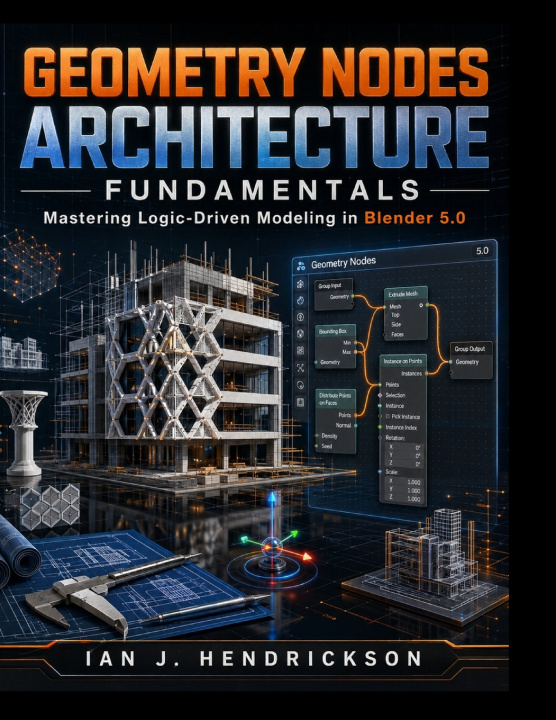
Geometry Nodes Architecture Fundamentals
Mastering Logic-Driven Modeling in Blender 5.0
 Engleski
 40 b
40 b
 Pripremamo
 Novo
Novo
Do 30 dana za povrat

Have you ever built something in 3D that looked incredible... until someone asked you to change it?
If you've spent hours modeling a scene by hand, only to watch an entire afternoon evaporate because a client wanted the wall two meters longer, you already know the real problem in 3D work isn't creativity. It's revision.
This book exists to fix that.
Geometry Nodes Architecture Fundamentals is a complete, ground-up guide to procedural modeling using the node-based geometry system found in the latest version of the popular open-source 3D creation suite. Instead of teaching you to build objects, it teaches you to build systems - flexible, adjustable, production-ready tools that respond instantly to change instead of demanding you start over.
So who is this book actually for?
If you're an artist tired of rebuilding the same asset from scratch every time a director changes their mind, this book is for you. If you're a technical artist trying to move from "I can follow tutorials" to "I understand why this works," this book is for you. And if you're aiming for a career in games, animation, or motion design and keep hearing that procedural skills are what studios are actually hiring for right now, this book was written with exactly that goal in mind.
What makes it different from the dozens of quick-tip videos scattered across the internet?
Structure. Depth. And a refusal to skip the boring parts that actually matter.
Across twenty carefully sequenced chapters, you'll move from foundational concepts - how geometry, attributes, and data actually behave inside a node tree - through scattering, curve-based design, simulation, procedural materials, animation, and full production pipelines. You won't just learn what a node does. You'll learn how to debug one when it breaks, how to optimize a tree that's grinding your scene to a halt, and how to package your work into something a teammate can actually pick up and use without asking you fifty questions.
Every chapter includes real, applied case studies - not toy examples. You'll build vegetation systems that respond to terrain slope. Cable and pipe networks that generate themselves between anchor points. A fully parametric furniture generator. A simulated erosion system that carves believable terrain on its own. By the final chapter, you'll design a complete, portfolio-ready procedural asset system from scratch, using everything the book has taught you along the way.
Curious whether this is written for beginners or advanced users?
Honestly, both - as long as you're willing to put in the work. The early chapters assume no prior node-based experience and build your understanding brick by brick. The later chapters go deep enough into performance architecture, scripting automation, and studio pipeline integration that even working technical artists will find genuinely new material here.
Here's what you can expect to walk away with:
A real, working understanding of how procedural systems are actually structured - not memorized node combinations, but the underlying logic that lets you solve problems you've never seen before.
The ability to debug a broken system methodically instead of guessing and hoping.
The skill to build tools that are genuinely reusable, cleanly documented, and ready for a real production pipeline - not just a personal file only you can understand.
And a clear, honest picture of how these skills translate into actual career opportunities across games, film, and motion design.
This isn't a book of shortcuts. It's a book that respects your time by teaching you the thinking behind the technique, so the technique still makes sense five years and several software updates from now.
If you're ready to stop rebuilding your work from scratch and start designing systems that adapt with you, this book is where that shift begins.


Informacije o knjizi
Engleski
