
 Kontakt
 Kako kupovati
Dostava
Savjetnik za kupnju
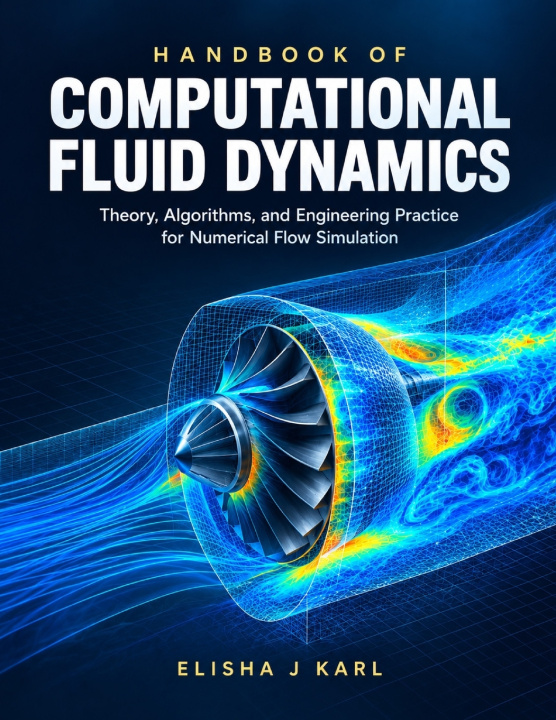
HANDBOOK OF COMPUTATIONAL FLUID DYNAMICS
Theory, Algorithms, and Engineering Practice for Numerical Flow Simulation
 Engleski
 234 b
234 b
 Pripremamo
 Novo
Novo
Do 30 dana za povrat

CFD becomes difficult when the solver is easier to operate than the mathematics behind it. A converged calculation is not automatically a trustworthy engineering result. Mesh resolution, boundary conditions, turbulence modelling, discretization, numerical stability, convergence, verification, validation, and uncertainty all influence what a simulation can tell you.
Handbook of Computational Fluid Dynamics is built to connect those pieces. It moves from the governing physics and mathematical foundations through discretization and solver methods to advanced engineering applications, scalable computing, optimisation, uncertainty, and data-driven approaches.
Inside, you will explore:
- The complete CFD workflow, from problem definition, meshing, and model selection to solving, post-processing, verification, and validation.
- Finite difference, finite volume, and finite element formulations, with attention to stability, accuracy, flux treatment, weak formulations, stabilisation, and adaptive methods.
- Turbulence modelling with RANS, LES, hybrid approaches, wall treatment, transition modelling, and model-selection strategy.
- Mesh generation and grid quality, including structured and unstructured meshes, boundary-layer resolution, adaptive refinement, mesh independence, and convergence assessment.
- Numerical solution procedures, pressure-velocity coupling, iterative linear solvers, preconditioning, and computational stability.
- Heat transfer, species transport, combustion, multiphase flow, rotating machinery, aeroacoustics, and fluid-structure interaction.
- Adjoint optimisation, uncertainty quantification, parallel computing, GPU acceleration, and machine-learning methods for computational modelling.
A central theme is engineering judgement. The book treats verification and validation, discretization and modelling error, convergence, mesh refinement, uncertainty, and comparison with analytical or experimental evidence as essential parts of responsible computational practice-not as final checks added after the analysis.
The seventeen-chapter structure progresses from introductory concepts and governing equations to PDE classification, spatial discretization, turbulence, mesh generation, numerical methods, multiphysics, specialised applications, optimisation, uncertainty, high-performance computing, and contemporary data-driven methods. Worked examples provide calculation-focused practice with unit tracking, while end-of-chapter problems and solutions reinforce the methods. A glossary, notation section, subject index, fluid-property tables, dimensionless-number reference, and turbulence-model constants support continued use as a technical reference.
This handbook is suited to upper-level engineering students with foundations in fluid mechanics and mathematics, as well as practising engineers who want a deeper and more systematic understanding of the methods behind their CFD results.
If you want to approach CFD as a disciplined combination of physics, mathematics, numerics, modelling, and engineering judgement, open the handbook and build that foundation from first principles to advanced computational practice.


Informacije o knjizi
Engleski

Poklonite ovu knjigu još danas
To je jednostavno
1 Dodajte knjigu u košaricu i odaberite isporuku kao poklon 2 Zauzvrat ćemo vam poslati kupon 3 Knjiga dolazi na adresu poklonoprimcaDobar dan! Ja sam Libroamiko, vaš književni savjetnik.
Kako vam mogu pomoći?