
 Kontakt
 Kako kupovati
Dostava
Savjetnik za kupnju
 Engleski
 102 b
102 b
 Pripremamo
 Novo
Novo
Do 30 dana za povrat

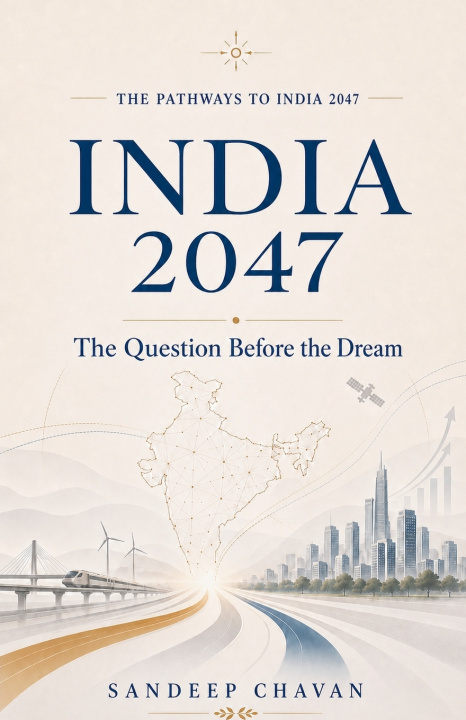
India has a dream for 2047.
But what exactly would it mean to arrive?
Would India become developed when its GDP reaches a particular size? When per-capita income crosses a threshold? When its infrastructure becomes world class? When it leads in technology? When its companies compete globally? When ordinary households become economically secure?
India 2047: The Question Before the Dream begins before forecasts and policy prescriptions. It asks a more fundamental question:
What would a developed India actually look like?
In the first volume of The Pathways to India 2047, Sandeep Chavan examines the architecture beneath India's national ambition.
The journey moves from GDP and per-capita income into the deeper structures that determine whether growth becomes development: productivity, demographic transition, employment, household resilience, health, education, skills, infrastructure, institutional capacity, manufacturing depth, technological capability, regional opportunity and environmental resilience.
Along the way, the book develops a series of critical distinctions:
- Large Economy ≠ High-Capability Society
- Schooling ≠ Learning
- Credential ≠ Capability
- Employment ≠ Acceptable Economic Resolution
- Infrastructure Access ≠ Infrastructure Reliability
- Technology Adoption ≠ Technology Capability ≠ Technology Ownership
- National Achievement ≠ Distributed Consequence
The book also asks readers to look beyond India's strongest success stories.
A country can contain world-class companies, cities, technologies and institutions while large parts of the economic field operate through very different levels of productivity and opportunity.
This leads to one of the book's central propositions:
A country's world-class nodes do not necessarily reveal the condition of the field between those nodes.
Rather than accepting or rejecting the language of Viksit Bharat and Atmanirbharta politically, the book asks what structural conditions those ambitions would require.
Its deeper formulation is Development as Increased Resolution Capacity:
Development is the increasing capacity of people, enterprises, institutions, and systems to convert persistent needs, constraints, and opportunities into viable consequences.
The result is neither a prediction of inevitable Indian ascent nor an argument for pessimism.
It is a framework for asking better questions.
Because India will reach 2047.
The real question is what capabilities, institutions, productive systems and human possibilities will have accumulated by the time it does.
And once the destination becomes clearer, another question appears:
If India knows where it wants to go, are the aspirations being generated among its people aligned with the pathways capable of taking them there?
That is where the next book begins.


Informacije o knjizi
Engleski
