
 Kontakt
 Kako kupovati
Dostava
Savjetnik za kupnju
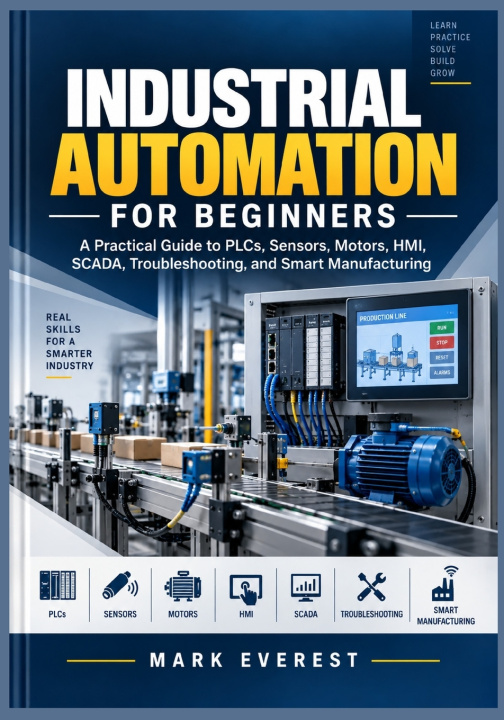
INDUSTRIAL AUTOMATION FOR BEGINNERS
A Practical Guide to PLCs, Sensors, Motors, HMI, SCADA, Troubleshooting, and Smart Manufacturing
 Engleski
 49 b
49 b
 Novo
Novo
Do 30 dana za povrat

Have you ever looked at a modern machine, watched it sense, decide, move, and respond automatically, and wondered how all those parts work together so seamlessly?
Modern production systems can seem intimidating when you are just starting out. Controllers, sensors, motors, drives, operator interfaces, communication systems, alarms, and troubleshooting methods can quickly become a confusing collection of unfamiliar terms. The real challenge is not simply learning what each component is called. It is understanding how the components interact, how information moves through a system, how decisions are made, and how to recognize what has gone wrong when a machine does not behave as expected. Without a clear learning path, beginners can easily memorize terminology without developing the practical understanding needed to work confidently with real systems.
This book provides a structured and practical way to build that understanding from the ground up. Concepts are introduced in clear language and connected to realistic applications so you can see not only what a component does, but also why it is used and how it fits into a complete system. You will progress from fundamental concepts to controllers, field devices, motors and drives, operator interfaces, supervisory systems, communication networks, system design, practical projects, troubleshooting, safety, cybersecurity, smart manufacturing, and career development. Throughout the book, practical examples and guided projects help turn theoretical knowledge into usable technical skills.
What You Will Gain From This Book:
Build a strong technical foundation without being overwhelmed by unnecessary complexity.
Understand how sensors, controllers, motors, drives, and interfaces work together within a complete system.
Develop practical PLC programming knowledge, including logic, timers, counters, sequencing, interlocks, and control decisions.
Understand HMI and SCADA systems and how operators interact with machines and production processes.
Learn the fundamentals of industrial communication and how connected devices exchange information.
Learn how to approach system design by defining processes, inputs, outputs, sequences, alarms, and operating conditions.
Work through realistic automation projects involving conveyors, counting systems, tank-level control, sorting, and motor control.
Develop systematic troubleshooting skills instead of relying on guesswork when equipment fails.
Understand essential safety and cybersecurity principles that should influence the design and operation of modern systems.
Discover smart manufacturing technologies such as connected machines, industrial IoT, machine vision, robotics, digital twins, and artificial intelligence.
Create a practical learning and career roadmap for developing your skills beyond the book.
Build a technical portfolio through projects that demonstrate your ability to understand, design, test, and troubleshoot systems.
Whether you are a student, aspiring technician, engineer, career changer, or simply someone who wants to understand how modern automated equipment works, this book gives you a practical foundation you can continue building on.
Stop memorizing disconnected technical terms. Start understanding how complete systems work, how they are designed, and how to solve problems when they fail. Get your copy today and begin building the practical skills that can take your knowledge from the classroom into the real world.


Informacije o knjizi
Engleski

Poklonite ovu knjigu još danas
To je jednostavno
1 Dodajte knjigu u košaricu i odaberite isporuku kao poklon 2 Zauzvrat ćemo vam poslati kupon 3 Knjiga dolazi na adresu poklonoprimcaDobar dan! Ja sam Libroamiko, vaš književni savjetnik.
Kako vam mogu pomoći?