
 Kontakt
 Kako kupovati
Dostava
Savjetnik za kupnju
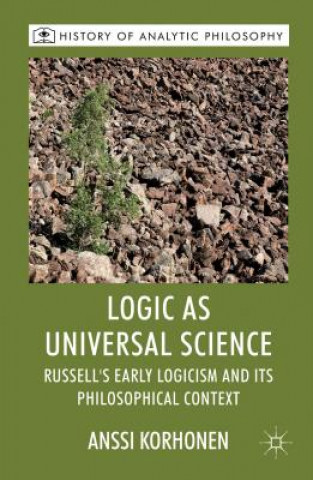
Logic as Universal Science
 Engleski
 135 b
135 b
30 dana za povrat kupljenih proizvoda
Kupci su kupili i


















 /
/
 Meki uvez
 12.63
€
12.63
€



 /
Meki uvez
32.06
€
/
Meki uvez
32.06
€
 /
Meki uvez
26.90
€
/
Meki uvez
26.90
€



Bertrand Russell was a central figure in the rise of analytic philosophy, and there are few works in the genre whose influence is comparable to The Principles of Mathematics (1903), a book that established him as a major force in British philosophy. Logic as Universal Science takes a fresh look at the context of The Principles. This, it is argued, involves an extended argument against Kant's transcendental idealism and his conception of mathematics as a synthetic a priori science grounded in pure intuition. Philosophically, Russell's logicism substitutes pure logic for pure intuitions as the true source of mathematical knowledge. In this way, logic turns out to be a universal science and very far from Kant's general logic, which is a concise and dry science, delivering nothing but a purely formal criterion for knowledge. The picture of logic emerging from this opposition is investigated in detail for its content and consequences.


Informacije o knjizi
Engleski

Poklonite ovu knjigu još danas
To je jednostavno
1 Dodajte knjigu u košaricu i odaberite isporuku kao poklon 2 Zauzvrat ćemo vam poslati kupon 3 Knjiga dolazi na adresu poklonoprimcaMoglo bi vas zanimati i

 /
Meki uvez
42.78
€
/
Meki uvez
42.78
€






 /
Tvrdi uvez
39.24
€
/
Tvrdi uvez
39.24
€





 /
Tvrdi uvez
26.90
€
/
Tvrdi uvez
26.90
€







Dobar dan! Ja sam Libroamiko, vaš književni savjetnik.
Kako vam mogu pomoći?