
 Kontakt
 Kako kupovati
Dostava
Savjetnik za kupnju
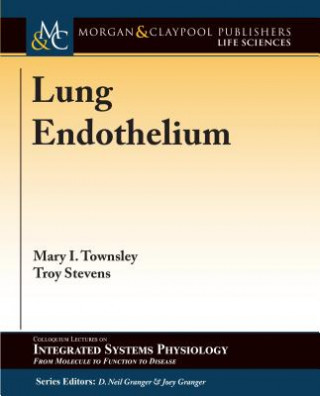
Lung Endothelium
 Engleski
 79 b
79 b
Do 30 dana za povrat
Kupci su kupili i






 /
/
 Knjiga
 8.67
€
8.67
€







 /
Meki uvez
52.97
€
/
Meki uvez
52.97
€

Pulmonary endothelium forms the inner lining of blood vessels, where it interprets the complex mechanical and chemical environment within the circulation and adjusts its behavior to facilitate vascular homeostasis. Although endothelium fulfills many essential functions, including regulation of vascular pressure, circulating cell transmigration, coagulation, and hormone metabolism and/or delivery, a principal role is to form a semi-permeable barrier that limits fluid, solute and macromolecular access to the interstitial space. Physiological properties that govern such permeability characteristics are defined by the Starling equation, which assumes that endothelial cells throughout the circulation are all alike. However, in recent years it has become evident that endothelial cells in pulmonary arteries, capillary and veins are heterogeneous in structure and function. Here, we review evidence for endothelial heterogeneity among these pulmonary vascular segments, and consider the implications for such heterogeneity in lung fluid balance, especially as it relates to the Starling equation.


Informacije o knjizi
Engleski
Kategorija

Poklonite ovu knjigu još danas
To je jednostavno
1 Dodajte knjigu u košaricu i odaberite isporuku kao poklon 2 Zauzvrat ćemo vam poslati kupon 3 Knjiga dolazi na adresu poklonoprimcaMoglo bi vas zanimati i


 /
Meki uvez
12.10
€
/
Meki uvez
12.10
€








 /
Tvrdi uvez
258.82
€
/
Tvrdi uvez
258.82
€







Dobar dan! Ja sam Libroamiko, vaš književni savjetnik.
Kako vam mogu pomoći?