
 Kontakt
 Kako kupovati
Dostava
Savjetnik za kupnju
 Engleski
 65 b
65 b
 Novo
Novo
Do 30 dana za povrat

Large-format hardcover edition.
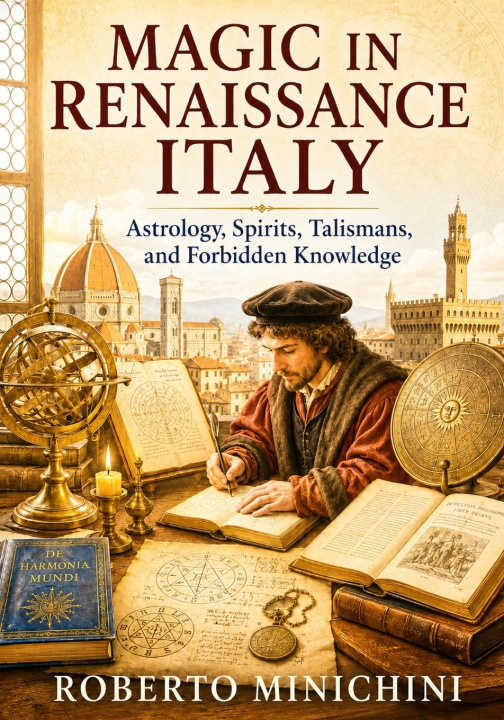
"MAGIC IN RENAISSANCE ITALY"
"Astrology, Spirits, Talismans, and Forbidden Knowledge"
By Roberto Minichini
What did magic mean to an educated Italian during the Renaissance? The answer leads far beyond modern images of superstition or sorcery. Between the late Middle Ages and the early seventeenth century, astrology, natural philosophy, medicine, talismanic images, celestial influences, Christian Cabala, spirit invocation, and forbidden ritual formed a complex intellectual world whose boundaries were constantly debated.
"MAGIC IN RENAISSANCE ITALY" reconstructs that world through its thinkers, texts, courts, universities, political conflicts, and religious institutions. Beginning with Pietro d'Abano and Cecco d'Ascoli, the book explains how Arabic-Latin transmission and works such as the "Picatrix" introduced sophisticated theories of astral power, occult qualities, and celestial images into European learned culture.
Marsilio Ficino stands at the center of the Florentine revival. His ideas concerning "spiritus," planetary correspondences, music, medicine, and images show why apparently magical operations could be defended as applications of natural philosophy. Giovanni Pico della Mirandola opens another field through the "900 Conclusions," Christian Cabala, Hebrew sacred language, natural magic, and his later attack on divinatory astrology.
The study then enters the practical world of astrologers and princely courts. Ferrara, Milan, and Rome reveal why rulers sought extraordinary expertise when war, illness, succession, dynastic survival, and diplomatic uncertainty made information exceptionally valuable. Talismans and astral images lead to the clandestine culture of learned necromancy, where clerical literacy, Latin manuscripts, sacred names, ritual circles, and spirit conjurations created a very different form of occult practice.
Johannes Trithemius and Heinrich Cornelius Agrippa illuminate the European circulation of secret knowledge through manuscripts, travel, patronage, and printing. Agrippa's "Three Books of Occult Philosophy" gave natural, celestial, and ceremonial magic one of its most influential Renaissance syntheses. Giordano Bruno receives sustained treatment through memory, imagination, universal animation, "De magia," and "De vinculis in genere." His execution in Rome in 1600 is examined without reducing the case either to the myth of a scientist martyred for heliocentrism or to a single accusation of magical practice.
The final section follows the regulation of dangerous knowledge through the Roman Inquisition founded in 1542, the Roman "Index of Prohibited Books" of 1559, the papal bull "Coeli et terrae Creator" of 1586, and the career of Tommaso Campanella. His combination of natural philosophy, astrology, prophecy, rebellion, imprisonment, and later papal patronage shows how Renaissance traditions survived while entering a changing seventeenth-century world.
Rich in historical dates, primary texts, political context, and detailed explanation, this volume presents Renaissance magic as a serious problem in the history of knowledge: how far did nature's hidden powers extend, could celestial influences be directed, and where did legitimate inquiry become forbidden spiritual practice?
About the Author
Roberto Minichini is a writer, poet, essayist, astrologer, and independent scholar. Born in Mainz, Germany, in 1973 to an Italian father and a Croatian mother, he writes on the history of religions, esotericism, philosophy, literature, astrology, and European and Asian intellectual traditions. His work emphasizes historical context, the transmission of ideas between cultures, and the changing relationship between religion, philosophy, and esoteric knowledge.


Informacije o knjizi
Engleski
