
 Kontakt
 Kako kupovati
Dostava
Savjetnik za kupnju
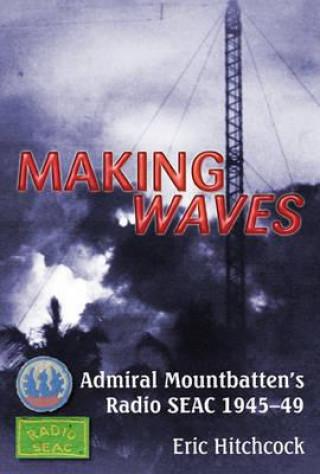
Making Waves
 Engleski
 128 b
128 b
Do 30 dana za povrat
Kupci su kupili i







 /
/
 Meki uvez
 18.23
€
18.23
€









The story of British Forces Broadcasting began officially on 1st January 1944 in North Africa. Mobile stations were used in the advance northwards through Italy, and followed closely behind the troops after D-Day as they fought their way across Europe into Germany. However, this approach was not suitable for the war east of Suez. The India and South-East Asia Commands (SEAC) covered such a huge area that other means were needed to deliver programmes to the forces in that theatre. A start had been made in Delhi in 1944, where a station had been set up which used air time provided by All-India Radio on one of its transmitters. Efforts to improve welfare facilities were made by Vice-Admiral Mountbatten, soon after he arrived to take up his appointment as Supreme Allied Commander, South East Asia. He set up a forces newspaper, and started experimental radio transmissions, but found there were financial constraints on what could be achieved. Friends and relatives back home became unhappy about the forces' living conditions, and articles appeared in the English press. These came to Churchill's notice, and he was persuaded to send Lord Munster on a fact-finding tour to establish what improvements were needed. His report was made available to M.P.'s just before Christmas 1944, when Churchill addressed the Commons on the situation. Lord Munster had noted the station in Delhi, but wrote that transmitters were needed for forces broadcasting, and that many more receiving sets were required. Discussions involving the War Office and the BBC reached the conclusion that the best option was a powerful short wave transmitter, supported by another with less power. This was approved by the War Cabinet, along with most of Munster's recommendations. What was much more difficult to resolve was the disagreement between those who wished to have the station in Delhi, and Mountbatten who wanted it under his command, in Ceylon. The text of a signal is included in which he set out his reasons. The furious argument was decided in his favour, and the result was Radio SEAC. Early estimates of targets for when the station might go on the air proved to be optimistic. They underestimated the difficulty of shipping, from England to Ceylon, the components of a big transmitter, complete with its own power supply. Several aerial towers (300 feet high) had to be dismantled, shipped and re-erected. In order to provide some broadcasting as soon as possible, the small transmitter was used for about a year before the powerful one went on the air in May 1946 - long after the war was over. Even readers with some knowledge of the technical details of radio receivers may be surprised by photographs showing the sheer size of the components used in the big transmitter. One could justify the huge expense of the transmitting station on the grounds that when it was not longer needed for forces broadcasting it could serve as a relay station for the BBC. This would mean, for example, that the BBC Overseas Service would be received well in Australia. It was used in this way for a short time, but independence for Ceylon led to the station being handed over to the country's new government. The story of Radio SEAC, and Mountbatten's pivotal involvement in it, has remained untold until now. Eric Hitchcock presents a balanced and fascinating account, blending military, social, political and scientific history together to produce an important account.


Informacije o knjizi
Engleski

Poklonite ovu knjigu još danas
To je jednostavno
1 Dodajte knjigu u košaricu i odaberite isporuku kao poklon 2 Zauzvrat ćemo vam poslati kupon 3 Knjiga dolazi na adresu poklonoprimcaMoglo bi vas zanimati i


 /
Meki uvez
30.29
€
/
Meki uvez
30.29
€
 /
Meki uvez
41.14
€
/
Meki uvez
41.14
€

 /
Meki uvez
54.82
€
/
Meki uvez
54.82
€










 /
Meki uvez
61.81
€
/
Meki uvez
61.81
€



Dobar dan! Ja sam Libroamiko, vaš književni savjetnik.
Kako vam mogu pomoći?