
 Kontakt
 Kako kupovati
Dostava
Savjetnik za kupnju
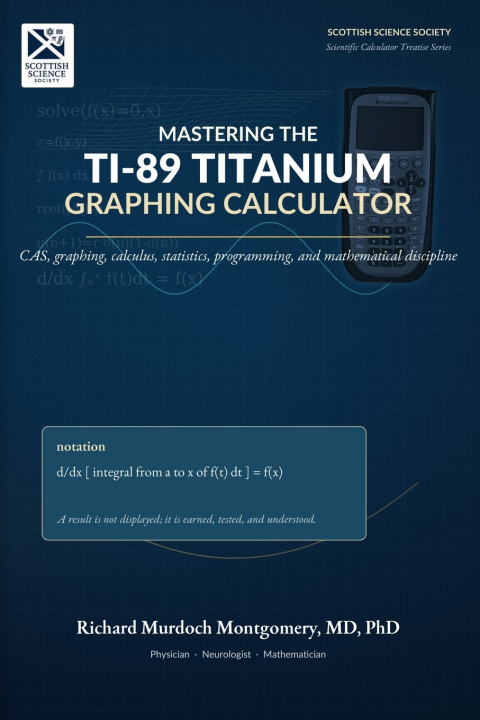
Mastering the TI-89 Titanium Graphing Calculator
A disciplined manual for exact calculation, symbolic reasoning, graphical enquiry, and calculator literacy
 Engleski
 101 b
101 b
 Novo
Novo
Do 30 dana za povrat

The TI-89 Titanium has the faintly comic dignity of an instrument that
has outlived several fashions. It is no longer new enough to frighten the
marketplace, nor old enough to be harmless. Its virtue lies elsewhere: it
remains a compact symbolic workstation, able to calculate numerically,
manipulate algebraically, draw graphs, store procedures, and expose the
operator who asked an imprecise question. That last service is among its
finest, though it seldom receives a medal.
This book is written for the student, engineer, examiner, teacher,
analyst, solitary investigator, impatient apprentice, returning scholar,
nocturnal problem-solver, and practical mathematician who wishes to
use the calculator without becoming its clerk. The tone is deliberately
argumentative. A calculator result is never accepted merely because the
screen is confident. It is compared with a model, an assumption, a
domain, a graph, a limiting case, or a unit.
The work also follows a typographical discipline. Where equations are
needed, variables are defined, notation is translated into meaning, and
derivations are supplied. No expression is allowed to fall from the sky
dressed as authority. The attached mathematical-notation model has
therefore been treated not as decoration, but as a compact constitution
for clarity.
The reader should keep the calculator near the page. This is a manual of
action as much as explanation. Keystrokes are not charms; they are
reproducible instructions. Enter them, predict the output, test the result,
and then ask whether the answer deserves citizenship in the problem.
A scientific calculator is often introduced as a convenience. The
description is true in the same way that a library is a convenient pile of
paper. The TI-89 Titanium deserves a sterner definition. It is a numerical
engine, a symbolic algebra system, a graphing environment, a matrix
laboratory, a statistics desk, a financial worksheet, and a programmable
companion. Each of these offices has its own grammar; confusion begins
when one office impersonates another.
This book therefore proceeds by dialectic. First comes the mathematical
claim; then the contrary temptation; then the calculator procedure; then
the verification. The device may solve an equation, but the operator must
decide whether the equation represented the problem. The device may
plot a curve, but the investigator must decide whether the window lied
by omission. The device may return an exact symbolic form, but
exactness without assumptions is merely punctual vanity.
The structure of the book follows the original table of contents. The early
chapters establish the body of the instrument and the grammar of entry.
Algebra and functions follow; graphing opens the visible theatre;
calculus and differential equations extend the inquiry; linear algebra and
statistics give the machine its heavier mathematical furniture; units,
science, finance, and programming complete the applied arc.
The method is practical but not servile. At every stage, the calculator is
used as a disciplined assistant. It does not replace derivation, judgement,
or mathematical memory. It makes their absence harder to excuse.


Informacije o knjizi
Engleski

Poklonite ovu knjigu još danas
To je jednostavno
1 Dodajte knjigu u košaricu i odaberite isporuku kao poklon 2 Zauzvrat ćemo vam poslati kupon 3 Knjiga dolazi na adresu poklonoprimcaDobar dan! Ja sam Libroamiko, vaš književni savjetnik.
Kako vam mogu pomoći?