
 Kontakt
 Kako kupovati
Dostava
Savjetnik za kupnju
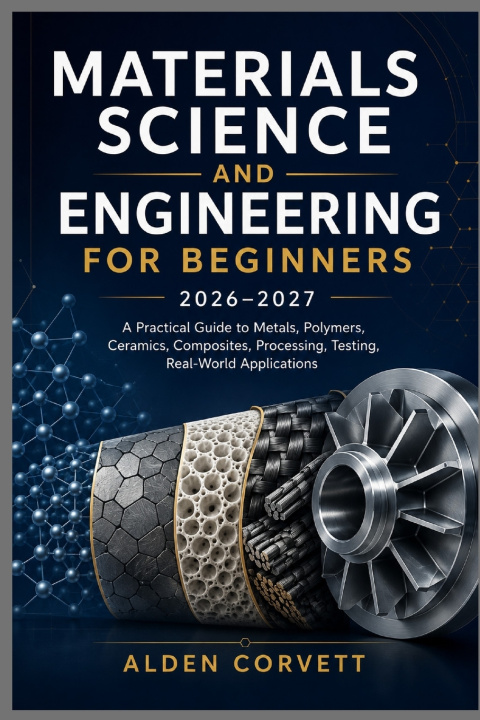
MATERIALS SCIENCE AND ENGINEERING FOR BEGINNERS 2026-2027
A Practical Guide to Metals, Polymers, Ceramics, Composites, Processing, Testing, Real-World Applications
 Engleski
 89 b
89 b
 Pripremamo
 Novo
Novo
Do 30 dana za povrat

What if you could finally understand how the materials behind the world around you work, why they behave the way they do, and how engineers choose the right ones for demanding applications?
Many beginners find this field difficult because it combines unfamiliar scientific principles, technical terminology, microscopic structures, manufacturing processes, testing methods, and real-world engineering decisions. Without a clear foundation, it can be easy to memorize definitions without understanding how concepts connect. Questions about why one material bends while another breaks, why heat treatment changes performance, how manufacturing affects internal structure, or why certain materials are selected for specific environments can quickly become overwhelming. This can make textbooks feel unnecessarily complicated and leave students, aspiring engineers, technicians, and self-learners unsure of where to start or how to build practical confidence.
This book provides a clear and accessible solution by presenting essential concepts in a structured, beginner-friendly way. Instead of assuming advanced prior knowledge, it explains fundamental principles step by step and connects scientific ideas to familiar engineering situations. Readers are introduced to different classes of materials, their important properties, how their internal structures influence performance, how processing changes those structures, how materials are tested and evaluated, and how engineers apply this knowledge when solving practical problems. The explanations are supported by carefully designed illustrations and practical examples that make difficult concepts easier to visualize and remember.
Inside, readers will learn how to:
- Understand fundamental material behavior with greater clarity and confidence.
- Recognize how atomic arrangement, microstructure, and defects influence performance.
- Compare metals, polymers, ceramics, and composites based on their useful characteristics.
- Understand how manufacturing and processing can change material properties.
- Connect mechanical, thermal, electrical, and environmental behavior to real applications.
- Develop a practical understanding of testing, characterization, and failure analysis.
- Recognize common causes of cracking, corrosion, wear, fatigue, and material degradation.
- Understand how engineers evaluate materials for different operating conditions.
- Build a stronger foundation for further study, technical training, and engineering practice.
- Approach unfamiliar material-related problems with a more systematic way of thinking.
Whether you are encountering these concepts for the first time, reviewing essential principles, preparing for further study, or looking for a practical reference you can return to, this book is designed to make the subject easier to understand and apply.
Give yourself a stronger technical foundation, build genuine confidence, and discover how the right understanding can turn complex engineering concepts into practical knowledge. Get your copy today and start learning with clarity.


Informacije o knjizi
Engleski

Poklonite ovu knjigu još danas
To je jednostavno
1 Dodajte knjigu u košaricu i odaberite isporuku kao poklon 2 Zauzvrat ćemo vam poslati kupon 3 Knjiga dolazi na adresu poklonoprimcaDobar dan! Ja sam Libroamiko, vaš književni savjetnik.
Kako vam mogu pomoći?