
 Kontakt
 Kako kupovati
Dostava
Savjetnik za kupnju
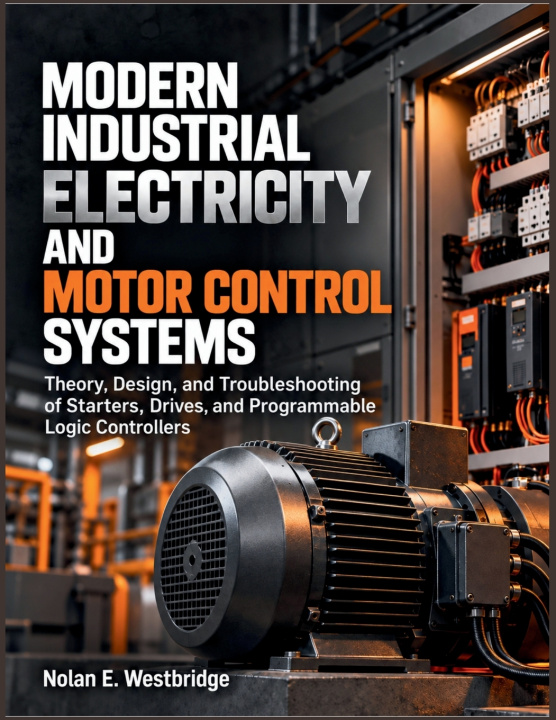
MODERN INDUSTRIAL ELECTRICITY AND MOTOR CONTROL SYSTEMS
Theory, Design, and Troubleshooting of Starters, Drives, and Programmable Logic Controllers
 Engleski
 81 b
81 b
 Novo
Novo
Do 30 dana za povrat

Master the electrical systems, motor circuits, control methods, and troubleshooting skills that power modern industry.
Industrial electrical systems can look intimidating-dense schematics, unfamiliar symbols, motor starters, relays, contactors, transformers, PLC interfaces, VFDs, protection devices, and control circuits all working together. But once you understand how these systems are built, how current flows through them, and how each component interacts, the complexity begins to make sense.
Industrial Electricity and Motor Controls is a practical, visually driven guide created to help you move from simply looking at an electrical diagram to confidently understanding what is happening, why it is happening, and what to check when something goes wrong.
Inside, you will explore the foundations of AC and three-phase electricity, transformers, grounding and protection, industrial electrical drawings, NEMA and IEC symbols, relays, contactors, motor starters, control transformers, sensors, timers, terminal wiring, reversing circuits, sequencing, braking methods, soft starters, variable-frequency drives, PLC-related control concepts, motor protection, troubleshooting, and much more.
What makes this book different is its emphasis on seeing how industrial electricity works. Carefully designed diagrams, control circuits, ladder schematics, phasor illustrations, wiring arrangements, operating curves, motor connections, troubleshooting charts, and practical examples help transform difficult concepts into information you can actually understand and use.
You will learn why industrial control circuits are designed the way they are, how motors are started, protected, reversed, stopped, and speed-controlled, when different control methods are appropriate, and what measurements or circuit sections to investigate when equipment fails to operate correctly.
The book also takes you beyond basic motor starters into the technologies found in modern industrial environments-including variable-frequency drives, pulse-width modulation, PLC-connected sensors, safety circuits, grounding and shielding practices, control-system troubleshooting, motor insulation testing, winding-resistance testing, and process-control applications.
This book is especially useful for electrical engineering students, industrial electricians, maintenance technicians, instrumentation and control personnel, automation technicians, apprentices, engineering instructors, plant maintenance teams, and practicing engineers who need a practical understanding of industrial power and motor-control systems.
If you work around motors, control panels, MCCs, industrial machinery, production equipment, pumps, fans, conveyors, drives, PLC systems, or electrical schematics, the knowledge inside these pages can help you read circuits more confidently, troubleshoot more logically, and make better technical decisions.
Instead of memorizing isolated symbols and formulas, you will begin to understand the complete system-from the incoming electrical supply to the control circuit, from the starter to the motor, and from the fault symptom back to its possible cause.
Industrial Electricity and Motor Controls is more than a textbook. It is a practical bridge between electrical theory, industrial drawings, motor-control logic, and real-world troubleshooting.
If you are ready to turn complicated industrial circuits into systems you can confidently read, understand, test, and troubleshoot, this book belongs on your desk, in your workshop, or beside you in the field.
Get your copy today and start building the industrial electrical and motor-control skills that matter in the classroom, workshop, and real world.


Informacije o knjizi
Engleski

Poklonite ovu knjigu još danas
To je jednostavno
1 Dodajte knjigu u košaricu i odaberite isporuku kao poklon 2 Zauzvrat ćemo vam poslati kupon 3 Knjiga dolazi na adresu poklonoprimcaDobar dan! Ja sam Libroamiko, vaš književni savjetnik.
Kako vam mogu pomoći?