
 Kontakt
 Kako kupovati
Dostava
Savjetnik za kupnju
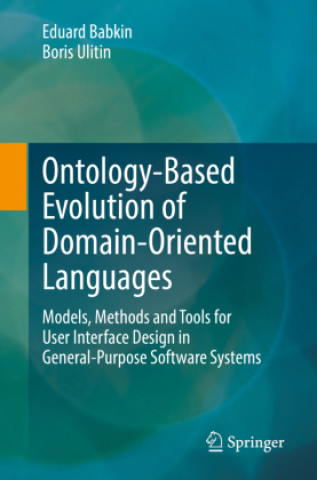
Ontology-Based Evolution of Domain-Oriented Languages
Models, Methods and Tools for User Interface Design in General-Purpose Software Systems
 Engleski
 274 b
274 b
Do 30 dana za povrat
Kupci su kupili i







This book focuses on the study of ontology-based models and methods used for the implementation of the evolution of external domain-specific languages (DSL), which are mainly intended for modelling the structure of human-machine interfaces. The primary goal of the approach is to increase the efficiency of support processes during the life cycle of general-purpose software systems.The book is structured in seven chapters. Chapter 1 presents the objectives and significance of the research, as well as a summary of the contents of the work. Chapter 2 analyses the existing classical DSL design and implementation methodology for modelling human-machine interfaces in the context of the lifecycle of general-purpose software systems. Next, chapter 3 is devoted to an analysis of existing methods and formalisms used in describing the structure of a DSL for modelling human-machine interfaces of software systems. Subsequently, chapter 4 provides a detailed description of the proposed new projection-based approach for developing such DSLs. Chapter 5 then describes the software implementation of the human-machine interface evolution based on an example of an external DSL in two domains. Eventually, chapter 6 analyses the application of the proposed projection approach for more complex systems, namely, decision support systems based on heterogeneous information of decision makers. The concluding chapter 7 summarizes the main results of the research and suggests further development paths and practical applications.The book is written for researchers in model-driven software development in general and in domain-specific language engineering in particular.


Informacije o knjizi
Engleski

Poklonite ovu knjigu još danas
To je jednostavno
1 Dodajte knjigu u košaricu i odaberite isporuku kao poklon 2 Zauzvrat ćemo vam poslati kupon 3 Knjiga dolazi na adresu poklonoprimcaMoglo bi vas zanimati i



 /
/
 Meki uvez
 17.45
€
17.45
€



Dobar dan! Ja sam Libroamiko, vaš književni savjetnik.
Kako vam mogu pomoći?