
 Kontakt
 Kako kupovati
Dostava
Savjetnik za kupnju
 Engleski
 51 b
51 b
 Novo
Novo
Do 30 dana za povrat

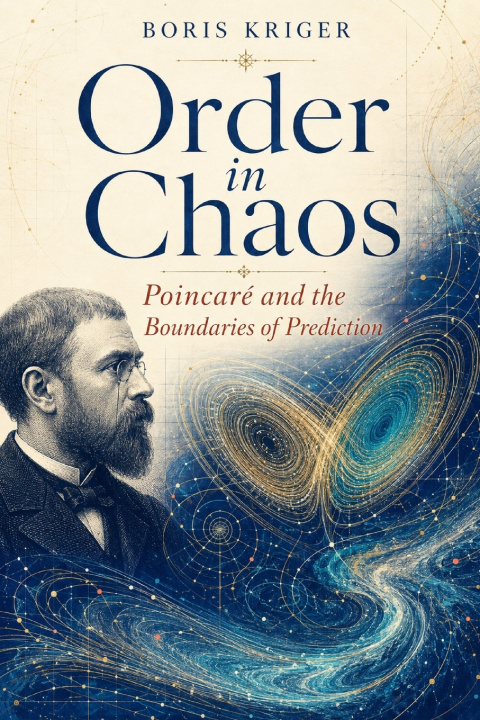
In 1889 the King of Sweden gave a prize to a young Frenchman for settling the oldest open question in astronomy: whether the solar system will hold together forever. He had not settled it. Worse, he found the error himself, after the memoir was printed and bound, and paid out of his own pocket to have the entire edition destroyed and reset. The corrected version contained something nobody had asked for and nobody wanted - a tangle of orbits so exquisitely sensitive to their starting point that no calculation, however patient, could follow them for long. Chaos was discovered by a man trying to prove that the heavens were orderly.
Henri Poincaré spent his working life walking up to the edges of what can be known and coming back with the coordinates. He showed that three bodies pulling on one another cannot be predicted forever. He argued that the geometry of space is chosen rather than found, and that clocks in different cities agree only because we have agreed that they should. He denied that mathematics could be reduced to logic, invented topology when calculation failed him, and left behind one last question about the shape of a closed space that took ninety-nine years to answer.
This is the story of the last man who held all of mathematics in one head, and of what he found where holding stops. It is also a book about the difference between not knowing something yet and not being able to know it at all - a distinction that has rarely mattered more than it does now, in an age that forecasts everything and is surprised by most of it.
Keywords: chaos, prediction, celestial mechanics, topology, philosophy of science, relativity, discovery


Informacije o knjizi
Engleski
