
 Kontakt
 Kako kupovati
Dostava
Savjetnik za kupnju
Palmprint Biometrics for Personal Identification
From Fundamentals to Intelligent Recognition Systems
 Engleski
 149 b
149 b
 Novo
Novo
Do 30 dana za povrat

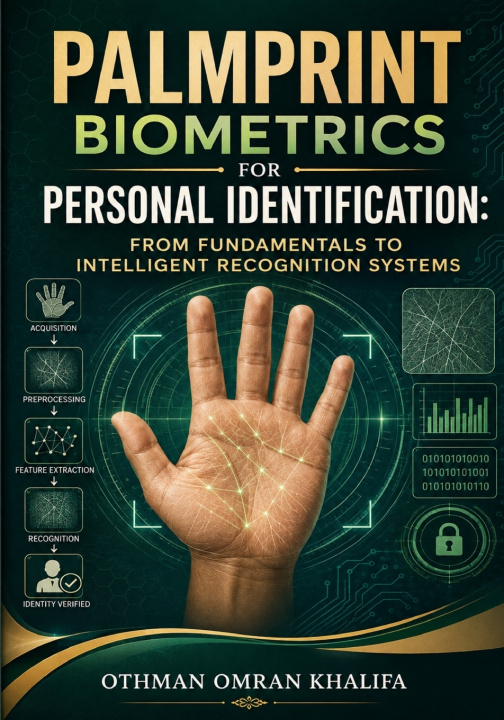
Palmprint Biometrics for Personal Identification: From Fundamentals to Intelligent Recognition Systems offers a comprehensive and contemporary examination of palmprint recognition, positioning it as a mature technology ready for widespread deployment in the era of intelligent systems. The book is structured to serve a diverse audience, from newcomers to experts, by providing a step-by-step journey from foundational concepts to cutting-edge algorithms and real-world applications.
The text begins by establishing the essential groundwork, covering the anatomy of the palm and the history of biometrics, followed by a detailed analysis of acquisition devices and the public databases that have fueled research progress. It then systematically builds a classical foundation through chapters dedicated to preprocessing, feature extraction, and matching techniques, critically evaluating the merits of established methods like line-based and texture-based features in various operational scenarios.
The core of the book's technical contribution lies in its deep dive into the transformative role of deep learning. Rather than treating these methods as opaque "black boxes," the authors provide a transparent and comprehensive explanation of advanced architectures-including convolutional networks, residual networks, Vision Transformers, and contrastive learning-specifically tailored for palmprint recognition.
Moving beyond algorithms, the latter half of the book addresses the critical challenges and future possibilities of the field. It tackles essential issues of security, privacy, and vulnerability to presentation attacks (spoofing). It then expands the scope from single-modal systems to a holistic, multimodal, systems-level perspective, reflecting the reality of complex real-world deployments. The book concludes with practical insights, presenting detailed case studies from diverse sectors such as border management, mobile authentication, healthcare, and finance, and looks forward to emerging developments like on-device AI, privacy-preserving federated learning, and the use of generative models for synthetic data creation.


Informacije o knjizi
Engleski
