
 Kontakt
 Kako kupovati

Dostava
Savjetnik za kupnju
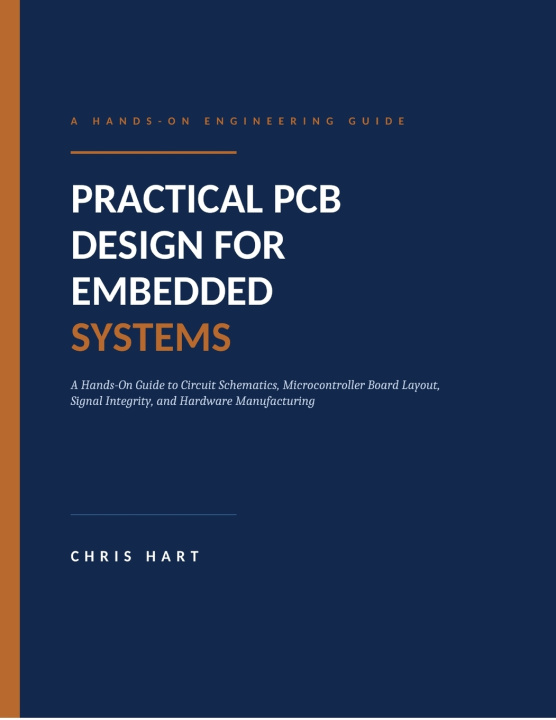
Practical PCB Design for Embedded Systems
A Hands-On Guide to Circuit Schematics, Microcontroller Board Layout, Signal Integrity, and Hardware Manufacturing
 Engleski
 65 b
 Pripremamo
 Novo
Do 30 dana za povrat

Design Better PCBs. Build More Reliable Embedded Systems.
A working circuit on a breadboard is only the beginning. Turning that circuit into a reliable, manufacturable printed circuit board requires careful engineering decisions involving component selection, circuit design, power management, signal integrity, routing, testing, and manufacturing.
Practical PCB Design for Embedded Systems provides a structured, engineering-focused approach to designing embedded hardware, taking you from initial requirements and component selection to fabrication, prototype validation, and production-ready boards.
Rather than treating PCB design as simply connecting components and routing traces, this book explores the electrical, physical, and manufacturing considerations that determine whether an embedded board performs reliably in the real world.
What You'll LearnPCB Design Fundamentals: Understand board architecture, design workflows, requirements engineering, and the relationship between schematics, layouts, and manufacturing files.
Component Selection: Evaluate microcontrollers, sensors, passive components, connectors, and integrated circuits using datasheets, electrical specifications, and lifecycle considerations.
Professional Schematic Design: Develop organized circuit schematics, design microcontroller support circuits, and implement reliable reset, clock, boot, and programming interfaces.
Power System Engineering: Design linear and switching regulators, battery-powered circuits, protection systems, and efficient power distribution.
PCB Layout and Routing: Work with board stack-ups, component placement, copper planes, trace geometry, grounding, and routing techniques.
Signal Integrity: Understand controlled impedance, differential pairs, USB, SPI, I²C, UART, ADC performance, and mixed-signal design.
Testing and Debugging: Design for testability, perform systematic first-power-on procedures, troubleshoot hardware faults, and validate prototypes.
EMC and Environmental Protection: Address electromagnetic interference, electrostatic discharge, transient protection, thermal management, humidity, and mechanical stress.
Manufacturing and Production: Prepare fabrication files, Gerbers, bills of materials, assembly documentation, and production release packages.
Throughout the book, you'll encounter numerical examples, engineering calculations, Python utilities, SPICE simulations, MicroPython examples, design checklists, and practical engineering workflows that help translate theory into real design decisions.
The examples include STM32 and ESP32-based embedded systems, sensor controllers, wireless monitoring hardware, and battery-powered data loggers.
Who Should Read This Book?This book is intended for:
Electronics and embedded systems engineers.
PCB designers and hardware developers.
Electrical and computer engineering students.
Microcontroller and IoT developers.
Electronics enthusiasts progressing beyond breadboard prototypes.
Engineers interested in PCB fabrication, validation, and production workflows.
Whether you're developing a sensor controller, an IoT device, a battery-powered data logger, or a custom microcontroller board, this book will help you approach PCB design with greater confidence, engineering discipline, and attention to reliability.
Move beyond breadboard prototypes. Develop embedded hardware with the engineering practices required for reliable, manufacturable PCB designs.


Informacije o knjizi
Engleski

Poklonite ovu knjigu još danas
To je jednostavno
1 Dodajte knjigu u košaricu i odaberite isporuku kao poklon 2 Zauzvrat ćemo vam poslati kupon 3 Knjiga dolazi na adresu poklonoprimcaDobar dan! Ja sam Libroamiko, vaš književni savjetnik.
Kako vam mogu pomoći?