
 Kontakt
 Kako kupovati
Dostava
Savjetnik za kupnju
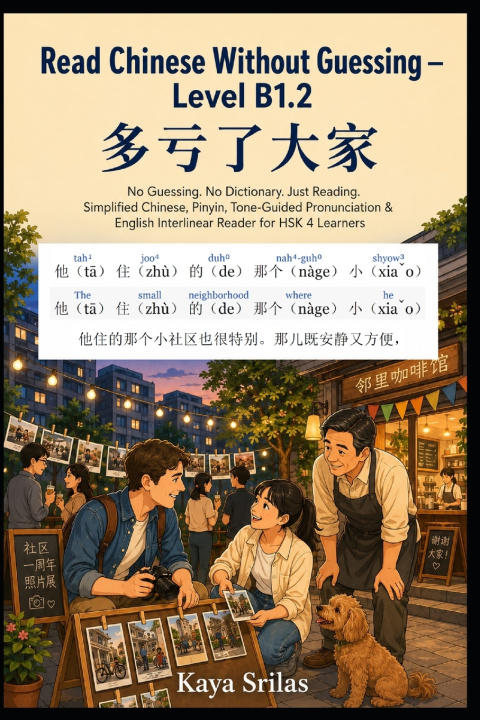
Read Chinese Without Guessing - Level B1.2
多亏了大家 - No Guessing. No Dictionary. Just Reading. Simplified Chinese, Pinyin, Tone-Guided Pronunciation & English Interlinear Reader for HSK 4 Learners
 Engleski
 84 b
84 b
 Novo
Novo
Do 30 dana za povrat

Read Chinese without guessing-and build longer, richer sentences naturally.
Read Chinese Without Guessing - Level B1.2: 多亏了大家 is the sixth graded reader in the series, for learners working toward HSK 4.
Lucas is ready to give something back. When 王先生(Wáng Xiānsheng / Mr. Wang)asks him to photograph the neighborhood for the café's anniversary, he begins to understand how many people have helped him build a life in Beijing.
No guessing.
No dictionary.
Just reading-with sound, meaning, and context together.
A Story of Gratitude and Belonging
With 小雨(Xiǎoyǔ / Xiaoyu)beside him and 可可(Kěkě / Coco)never far away, Lucas turns a photography project into a celebration of community. The story builds toward 多亏了大家-"Thanks to everyone."
B1.2 introduces the structures that transform short, correct sentences into connected, adult Chinese.
The Big Grammar of B1.2
- Reasons: 因为...所以..., 由于, 因此, and 于是
- Relative clauses: 我拍的照片-"the photo I took"
- 把 and 被: actions done to objects, people, or things
- Experience: 过 and 从来没...过
- Inference: 看起来, 好像, 听说, 据说
- Suggestions: 吧, 我们来..., 我来...
- Certainty: 应该, 估计, 肯定
- 就 vs 才: sooner versus later than expected
我拍的照片 places "I took" before "photo." 把 moves a definite object forward and requires a result: 我把照片挂在墙上. 被 gives the passive side: 我的照片被选中了.
Four Layers, One Reading Experience
- Simplified Chinese characters
- Pinyin
- Tone-guided English pronunciation
- English meaning
The blue layer shows how to say each word; the purple layer shows what it means. Everything stays together, with no page flipping, dictionary searching, or app required.
The Pinyin Fade Continues
The interlinear version always keeps full support. Every word includes characters, pinyin, pronunciation, and meaning.
The Chinese-only version keeps pinyin only on key vocabulary, above-level words, proper nouns, and irregular readings, while familiar words stand alone. Nothing is removed from the supported reading. A harder version appears when you are ready.
Inside Every Chapter
- Interlinear story with pronunciation and meaning
- The same story in cleaner Chinese with partial pinyin
- HSK-style reading comprehension
- Vocabulary and context practice
- Useful expressions and one focused grammar lesson
- Two writing tasks and complete answer keys
The Ten-Chapter Journey
You will explain why something happened, describe "the place I want to photograph," discuss experiences, report what you saw or heard, invite others to help, handle objects with 把, understand passive sentences with 被, and express gratitude naturally.
Who This Book Is For
This book is ideal if you have completed B1.1 and are ready for longer descriptions, reasons, reported information, 把, 被, and more independent character reading.
- Learners preparing for HSK 4
- Readers who prefer stories to isolated drills
- Visual learners who want pronunciation support
- Students ready to read common words without pinyin
Build Toward Real Chinese Reading
By the end, your cumulative reading vocabulary reaches roughly 2,200-3,000 words built from about 1,100 characters. You will be better prepared to give full reasons, build long descriptive sentences, distinguish seeing from hearsay, and describe actions through both 把 and 被.
Read aloud. Follow the tone numbers. Try the clean version. Return to the


Informacije o knjizi
Engleski

Poklonite ovu knjigu još danas
To je jednostavno
1 Dodajte knjigu u košaricu i odaberite isporuku kao poklon 2 Zauzvrat ćemo vam poslati kupon 3 Knjiga dolazi na adresu poklonoprimcaDobar dan! Ja sam Libroamiko, vaš književni savjetnik.
Kako vam mogu pomoći?