
 Kontakt
 Kako kupovati

Dostava
Savjetnik za kupnju
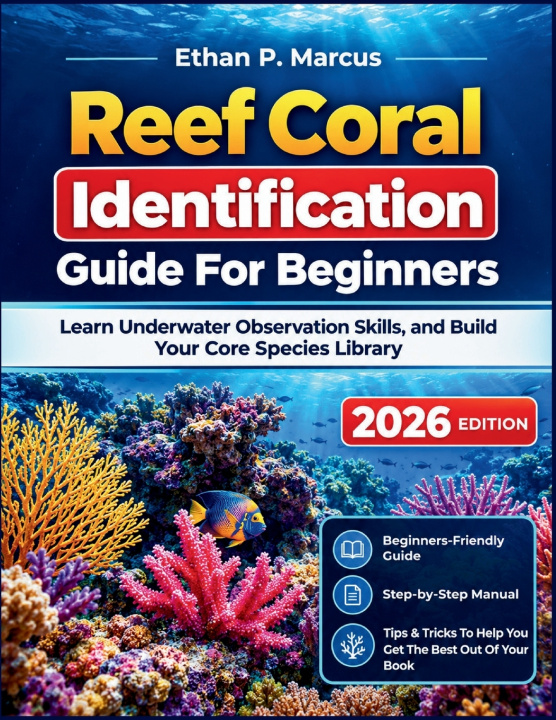
Reef Coral Identification Guide For Beginners
Learn Underwater Observation Skills, and Build Your Core Species Library
 Engleski
 55 b
 Pripremamo
 Novo
Do 30 dana za povrat

STOP MISREADING THE REEF. START IDENTIFYING CORAL WITH REAL CONFIDENCE.
- Are you dropping into the water, surfacing after every dive, and coming back with nothing but a vague impression of "brown stuff and purple fans"?
- Tired of field guides that open with Latin taxonomic keys, corallite septa diagrams, and species lists so dense they feel written for PhD candidates - not for the person who just got their Open Water certification last weekend?
You are not the problem. The books are.
Here is the truth that most coral identification guides will never tell you: in 2026, coral reef identification is not about memorizing hundreds of species from a photo catalogue and hoping the coral you find matches the picture you remember. It is about building a repeatable, logical system - a way of seeing, reading, and interpreting the reef that works in Florida, in the Bahamas, in Barbados, in Grand Cayman, at 2 meters depth on a patch reef and at 20 meters on a fore reef wall, in brilliant sunlight and in the pale filtered light of deep water. If you do not have a system, you will always be guessing. And guesswork is not identification - it is wishful thinking with a mask on.
Inside this guide, you will learn how to:
- Read Any Coral in Under 60 Seconds: Master the Four-Step ID Method - Color, Growth Form, Surface Texture, Habitat and Depth - the systematic, repeatable framework that professional reef ecologists use, now explained in plain language with step-by-step worked examples for every major Atlantic species. No guessing. No memorization marathons. Just a logical process that works every time.
- Identify the Reef's Most Important Species With Certainty: Work through detailed, comparison-first identification guides for every major coral group in Florida, the Caribbean, and the Bahamas - brain corals, star corals, gorgonians, fire coral, black coral, and more - including the specific visual features that separate look-alike species that even experienced divers confuse regularly.
- Read the Health of a Reef at a Glance: Understand what bleaching, SCTLD, White Band Disease, and dark spot disease actually look like - and how to distinguish between them with the precision that reef monitoring programs need from their citizen science observers. Know within two minutes of entering the water whether the reef you are on is thriving, stressed, or in active crisis.
- Understand What Grows Between the Coral: Learn to read algae cover - CCA versus turf versus macroalgae - as a real-time reef health indicator. Identify calcareous green algae that beginners mistake for coral. Understand what seagrass beds tell you about the connected ecosystem. Turn the "background" of the reef into readable, useful information.
BONUS SECTIONS
- Bonus 1 - Quick-Reference Species Cards
- Bonus 2 - The Dive-Day Checklist
- Bonus 3 - Glossary of Coral Science Terms in Plain English
- Bonus 4 - Conservation Resources and Further Reading
YOU DO NOT NEED DECADES UNDERWATER. YOU NEED A METHOD.
Whether you are snorkeling a Bahamian patch reef for the first time, doing your first Caribbean liveaboard, or a recreational diver who has been underwater for years and wants to finally understand what you have been looking at - this guide is your complete system.
The reef has been down there, in extraordinary complexity, this whole time.
Now you will know exactly what you are seeing.
Scroll up, click "Buy Now," and take your first step toward reading the reef - not just visiting it.


Informacije o knjizi
Engleski

Poklonite ovu knjigu još danas
To je jednostavno
1 Dodajte knjigu u košaricu i odaberite isporuku kao poklon 2 Zauzvrat ćemo vam poslati kupon 3 Knjiga dolazi na adresu poklonoprimcaDobar dan! Ja sam Libroamiko, vaš književni savjetnik.
Kako vam mogu pomoći?