
 Kontakt
 Kako kupovati
Dostava
Savjetnik za kupnju
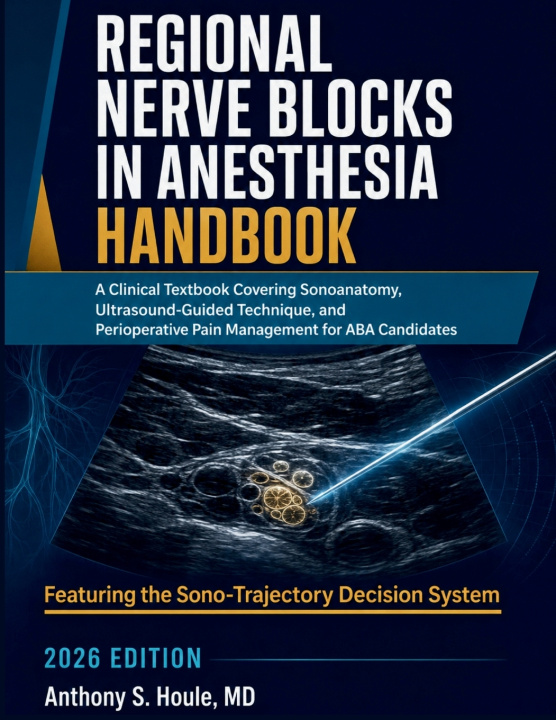
Regional Nerve Blocks in Anesthesia Handbook 2026
A Clinical Textbook Covering Sonoanatomy, Ultrasound-Guided Technique, and Perioperative Pain Management for ABA Candidates
 Engleski
 518 b
518 b
 Novo
Novo
Do 30 dana za povrat

This handbook connects the connective-tissue architecture of the peripheral nerve - endoneurium, fascicle, perineurium, epineurium - and the injection-pressure physiology that makes intraneural injury preventable, then carries that foundation through every major regional anesthesia target: brachial plexus, lumbar and sacral plexus, truncal fascial planes, head and neck, and neuraxial technique. Built around the Sono-Trajectory Decision System, a five-part clinical reasoning framework - The Target, Sono-Signature, The Trajectory Decision, Trap Logic, and Block Anchor - repeated at every anatomic site, it teaches the pattern behind the procedure, not forty-four isolated techniques. Written for anesthesiology residents, regional anesthesiology and acute pain medicine fellows, and practicing anesthesiologists sharpening ultrasound-guided technique.
Named vascular and pleural hazards at every target, bony-contact-first trajectory planning, and a consolidated, cross-referenced Atlas turn dense sonoanatomy into a decision you can defend at the bedside.
Inside, You Will Learn How To
• Confirm extraneural spread and injection pressure safety - recognize an atypical local anesthetic systemic toxicity presentation before it becomes cardiovascular collapse.
• Target the interscalene groove and supraclavicular corner pocket - trunk- and division-level trajectories with the trap logic that separates a nerve mimic from the real target.
• Walk the posterior psoas compartment to the lumbar plexus - bony-contact trajectory planning that keeps the needle out of the epidural space.
• Choose among paravertebral, erector spinae plane, TAP, and quadratus lumborum block - fascial plane selection for thoracic and abdominal coverage without crossing the pleura.
• Manage intercostal and interpleural technique's pneumothorax risk - rib walk-off and pleural-sliding confirmation at this book's closest pleural proximity.
• Integrate neuraxial and peripheral technique - combined spinal-epidural placement, cumulative dosing, and epidural hematoma vigilance for major joint and thoracic surgery.
• Adapt technique for pediatric, obstetric, and obesity-related practice - caudal epidural access, ideal-body-weight dosing, depth-adapted equipment selection.
• Build and sustain a regional anesthesia program - credentialing pathways, quality assurance structure, and the genicular and medial branch blocks that extend a program into chronic pain.
Equip yourself to defend every trajectory decision you make - for the patient on the table now, and the one after.


Informacije o knjizi
Engleski

Poklonite ovu knjigu još danas
To je jednostavno
1 Dodajte knjigu u košaricu i odaberite isporuku kao poklon 2 Zauzvrat ćemo vam poslati kupon 3 Knjiga dolazi na adresu poklonoprimcaDobar dan! Ja sam Libroamiko, vaš književni savjetnik.
Kako vam mogu pomoći?