
 Kontakt
 Kako kupovati

Dostava
Savjetnik za kupnju
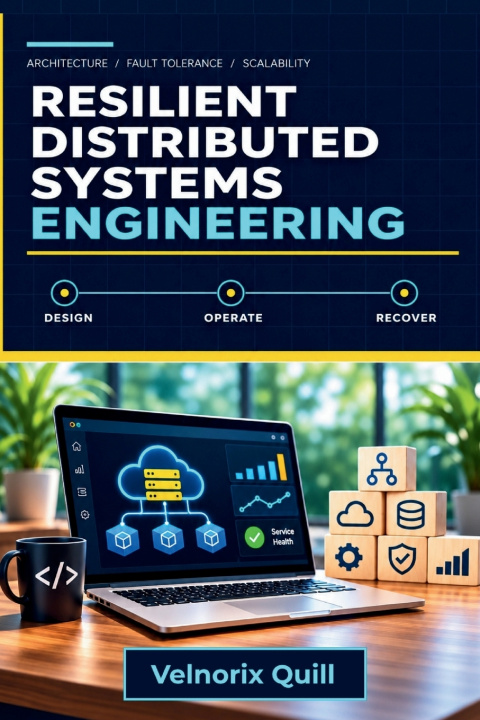
Resilient Distributed Systems Engineering
Managing Service Failures, Protecting Data, Monitoring Performance, and Restoring Reliable Cloud Applications
 Engleski
 111 b
 Pripremamo
 Novo
Do 30 dana za povrat

What happens when a critical service fails, a database becomes unavailable, or a sudden traffic spike pushes your application beyond its limits?
Modern distributed systems power everything from online shopping platforms to cloud applications and financial services. But keeping these systems dependable requires more than connecting services and deploying additional servers. Every network request, database transaction, and infrastructure dependency introduces challenges that engineers must understand and prepare for.
Resilient Distributed Systems Engineering is a practical guide to designing, building, and operating software that can handle failures, protect critical operations, and recover from disruptions. Whether you're a software developer, DevOps engineer, cloud professional, or aspiring reliability engineer, this book helps you understand the architectural decisions and operational practices behind dependable distributed applications.
Through straightforward explanations, realistic scenarios, and practical engineering examples, you'll explore how resilience fits into everyday software development.
Inside this guide, you'll learn how to:
Design dependable architectures: Understand microservices, event-driven communication, redundancy, and service boundaries that help limit failure propagation.
Handle service failures effectively: Apply timeouts, retries, circuit breakers, bulkheads, and graceful degradation to protect critical operations.
Build reliable communication workflows: Work with message queues, delivery guarantees, idempotency, and recovery strategies for failed messages.
Protect distributed data: Understand consistency models, replication, distributed transactions, and techniques for preventing data loss.
Improve production visibility: Use metrics, logs, distributed tracing, and OpenTelemetry to investigate performance problems and service disruptions.
Strengthen cloud-native reliability: Explore Kubernetes health probes, autoscaling, rolling updates, automated failover, and infrastructure recovery.
Test and improve resilience: Develop failure scenarios, conduct controlled experiments, and evaluate recovery procedures before real incidents occur.
The book also brings these concepts together through a practical distributed ordering application, showing how architectural decisions, data protection, observability, and recovery planning work together in a realistic engineering design.
Rather than focusing on theory alone, this guide explains why important resilience patterns exist, where they are useful, and what trade-offs engineers should consider before applying them.
Build systems with failure in mind, make better architectural decisions, and approach production reliability with greater confidence.
Start exploring the engineering practices that help distributed applications remain dependable when real-world conditions become unpredictable.


Informacije o knjizi
Engleski

Poklonite ovu knjigu još danas
To je jednostavno
1 Dodajte knjigu u košaricu i odaberite isporuku kao poklon 2 Zauzvrat ćemo vam poslati kupon 3 Knjiga dolazi na adresu poklonoprimcaDobar dan! Ja sam Libroamiko, vaš književni savjetnik.
Kako vam mogu pomoći?