
 Kontakt
 Kako kupovati
Dostava
Savjetnik za kupnju
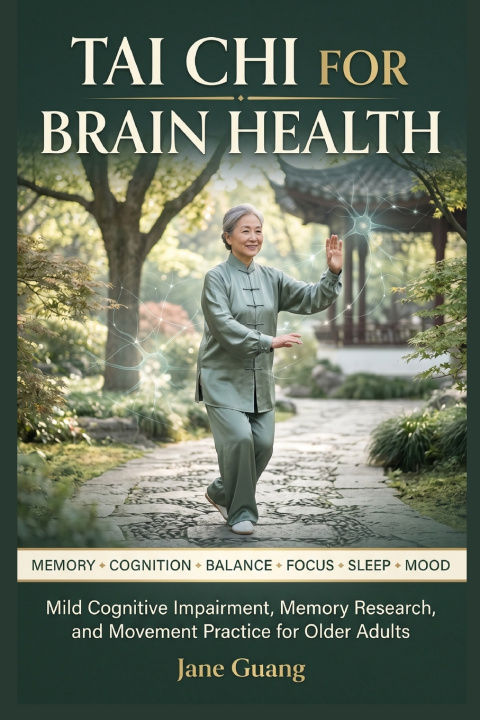
TAI CHI FOR BRAIN HEALTH
Mild Cognitive Impairment, Memory Research, and Movement Practice for Older Adults
 Engleski
 38 b
38 b
 Novo
Novo
Do 30 dana za povrat

TAI CHI FOR BRAIN HEALTH
Mild Cognitive Impairment, Memory Research, and Movement Practice for Older Adults
Margaret's doctor used the words "mild cognitive impairment" at a routine physical, at the same appointment where she'd blanked on a screening question. She called her Tai Chi teacher that evening, before she'd fully processed it, and asked whether it was too late to still help.
That question sits behind this book.
Jane Guang has taught Tai Chi for more than twenty years, and in that time she has watched something happen in nearly every class. Students forget a sequence, apologize, and start again. Some assume that's a sign their memory is failing. Often it isn't. It's the harder work of holding several things in mind at once, attention, balance, timing, coordination, which is a different skill than memory and one the research treats separately.
This book walks through what that research actually says. It covers the distinction between normal forgetfulness, mild cognitive impairment, and dementia, and works through the published studies on Tai Ji Quan chapter by chapter: what meta-analyses have found on memory, executive function, and global cognition, what a 2023 randomized trial on cognitively enhanced Tai Ji Quan showed about thinking while walking, and what brain-imaging research can and cannot yet tell us. Nothing here claims Tai Chi prevents or reverses dementia. The book says plainly where the evidence is strong, where it's promising but unproven, and where questions remain open.
The second half turns to practice. Readers will find a comparison of the major Tai Chi styles, an explanation of the 8-form and 24-form sequences, and a full walkthrough of eight foundational movements with standing, supported standing, and seated versions for each one. No prior experience is assumed. A chair and a small amount of space are enough to begin.
Chapters include:
The difference between normal aging, mild cognitive impairment, and dementia
What shapes brain health beyond exercise alone
Balance, dual-tasking, and the connection between moving and thinking
Research on Tai Chi and memory, executive function, and global cognition
The 2023 trial on cognitively enhanced Tai Ji Quan and its six-month follow-up
Sleep, mood, and stress in relation to cognitive aging
A comparison of Yang, Chen, Sun, and Wu styles
An eight-movement practice with standing, supported, and seated modifications
Open questions the current research hasn't answered yet
Margaret didn't need a promise that everything would be fine. She needed a clear account of what was known, what wasn't, and what she could reasonably do next. This book is written for readers in the same position: people who want to understand their aging brain without being sold a cure, and who are ready to start somewhere, even ten minutes at a time.


Informacije o knjizi
Engleski

Poklonite ovu knjigu još danas
To je jednostavno
1 Dodajte knjigu u košaricu i odaberite isporuku kao poklon 2 Zauzvrat ćemo vam poslati kupon 3 Knjiga dolazi na adresu poklonoprimcaDobar dan! Ja sam Libroamiko, vaš književni savjetnik.
Kako vam mogu pomoći?