
 Kontakt
 Kako kupovati
Dostava
Savjetnik za kupnju
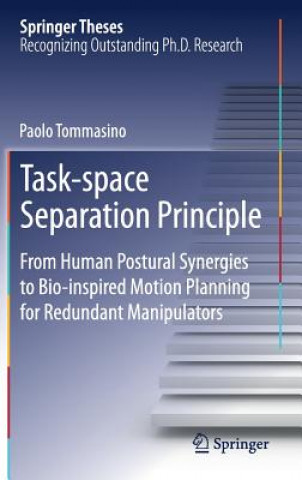
Task-space Separation Principle
From Human Postural Synergies to Bio-inspired Motion Planning for Redundant Manipulators
 Engleski
 249 b
249 b
Do 30 dana za povrat
Kupci su kupili i










This book addresses two fundamental issues of motor control for both humans and robots: kinematic redundancy and the posture/movement problem. It blends traditional robotic constrained-optimal approaches with neuroscientific and evidence-based principles, proposing a "Task-space Separation Principle," a novel scheme for planning both posture and movement in redundant manipulators. The proposed framework is first tested in simulation and then compared with experimental motor strategies displayed by humans during redundant pointing tasks. The book also shows how this model builds on and expands traditional formulations such as the Passive Motion Paradigm and the Equilibrium Point Theory. Lastly, breaking with the neuroscientific tradition of planar movements and linear(ized) kinematics, the theoretical formulation and experimental scenarios are set in the nonlinear space of 3D rotations which are essential for wrist motions, a somewhat neglected area despite its importance in daily tasks.


Informacije o knjizi
Engleski

Poklonite ovu knjigu još danas
To je jednostavno
1 Dodajte knjigu u košaricu i odaberite isporuku kao poklon 2 Zauzvrat ćemo vam poslati kupon 3 Knjiga dolazi na adresu poklonoprimcaMoglo bi vas zanimati i






 /
/
 Meki uvez
 14.25
€
14.25
€

 /
Tvrdi uvez
142.62
€
/
Tvrdi uvez
142.62
€


 /
Tvrdi uvez
150.01
€
/
Tvrdi uvez
150.01
€

 /
Meki uvez
56.84
€
/
Meki uvez
56.84
€


Dobar dan! Ja sam Libroamiko, vaš književni savjetnik.
Kako vam mogu pomoći?