
 Kontakt
 Kako kupovati
Dostava
Savjetnik za kupnju
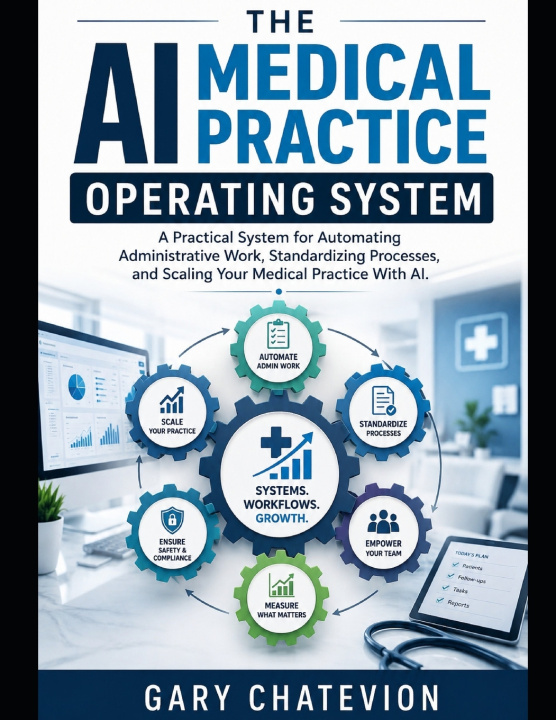
The AI Medical Practice Operating System
A Practical System for Automating Administrative Work, Standardizing Processes, and Scaling Your Medical Practice With AI
 Engleski
 40 b
40 b
 Pripremamo
 Novo
Novo
Do 30 dana za povrat

Your medical practice doesn't need more AI experiments. It needs a system.
AI can draft emails, organize information, summarize meetings, create SOPs, analyze patterns, improve patient communications, and reduce repetitive administrative work.
But a prompt that saves five minutes once is not a transformation.
The real opportunity begins when useful AI outputs become repeatable workflows with owners, standards, metrics, review processes, and safeguards.
The AI Medical Practice Operating System gives physicians, practice owners, managers, and healthcare administrators a practical framework for doing exactly that.
Inside, you'll learn how to:
• Identify the administrative tasks where AI can create the greatest operational value
• Decide what AI should-and should never-be allowed to do
• Build safe human-in-the-loop workflows
• Turn effective prompts into standardized templates and SOPs
• Reduce repetitive administrative work and recover staff capacity
• Improve scheduling, patient communication, documentation, marketing, and practice operations
• Give every workflow a clear owner, backup owner, metric, and review cadence
• Identify opportunities where automation can improve efficiency without creating unnecessary risk
• Measure whether an AI-assisted process is actually improving the practice
• Build systems that survive staff turnover instead of living inside one employee's memory
• Create a 30-day roadmap for putting an AI operating system into practice
At the heart of the book is a simple transformation:
PROMPT → TEMPLATE → WORKFLOW → SOP → OWNER → METRIC → REVIEW
That is the difference between experimenting with AI and building an AI-enabled medical practice.
You'll also get practical tools, including an AI readiness assessment, task-risk map, governance policy template, opportunity audit, workflow card, SOP template, metrics dashboard, quarterly review system, staff training checklist, and ready-to-adapt AI prompts.
Most importantly, this book does not treat AI as a replacement for professional judgment.
AI drafts, organizes, assists, and identifies patterns. Qualified humans verify, decide, approve, and remain accountable.
Whether you run a small independent practice or manage a growing outpatient organization, the goal is the same:
Stop adding AI tools to your practice. Start building a practice that knows how to use AI well.


Informacije o knjizi
Engleski
