
 Kontakt
 Kako kupovati
Dostava
Savjetnik za kupnju
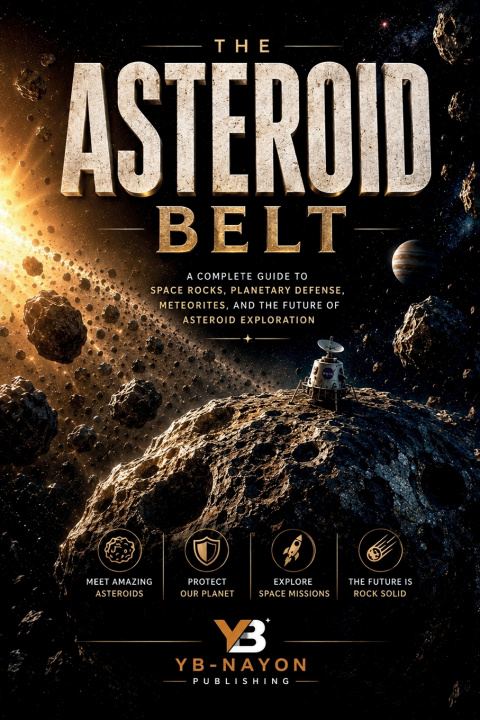
The Asteroid Belt
A Complete Guide to Space Rocks, Ceres, Vesta, Meteorites, Planetary Defense, the DART Mission, and Asteroid Mining for Kids Ages 8-12
 Engleski
 21 b
21 b
 Pripremamo
 Novo
Novo
Do 30 dana za povrat

Did you know that the asteroid belt between Mars and Jupiter is
mostly empty space - so empty that every spacecraft we have ever sent
through it has passed safely without hitting a single rock? That
meteorites falling to Earth carry amino acids, the building blocks of
life, that formed in space billions of years ago? That in September 2022,
humanity deliberately crashed a spacecraft into an asteroid and
successfully changed its orbit for the first time in history? And that
the dinosaurs were wiped out by an asteroid impact - but that same
impact may have eventually led to the rise of humans?
Inside this book, readers will discover:
- The Real Asteroid Belt - Why the densely packed asteroid
fields of science fiction movies are completely wrong, how empty the
real belt actually is, and why it still matters enormously as a
scientific treasure chest from the solar system's earliest history - Ceres: The Dwarf Planet - The largest object in the asteroid
belt and the only dwarf planet in the inner solar system, revealed by
NASA's Dawn spacecraft to have mysterious bright spots of sodium
carbonate salt, evidence of a subsurface ocean, and a cryovolcanic
dome that formed within the past 200 million years - Vesta: A Planetary Embryo - The second largest asteroid, a
differentiated world with an iron core, a basaltic crust, and two
enormous ancient impact craters covering most of its southern
hemisphere, connected to the HED meteorites that rain down on Earth - How the Belt Formed - Why no planet ever formed between
Mars and Jupiter, the role of Jupiter's gravity in disrupting planet
formation, the dramatic Grand Tack hypothesis in which Jupiter migrated
inward through the solar system and back, and how this migration may
have delivered Earth's water - Near-Earth Asteroids - The thousands of asteroids with
orbits that bring them close to Earth, how they escape from the main
belt through gravitational resonances, and the famous Apophis asteroid
whose discovery briefly suggested a 2.7 percent chance of hitting Earth
in 2029 - Meteorites - How pieces of asteroids travel from the belt
to Earth over millions of years, the different types of meteorites and
what they reveal about their parent bodies, why Antarctica is the best
place on Earth to find meteorites, and what the amino acids in
carbonaceous chondrites tell us about the origin of life - Asteroid Mining - The staggering mineral wealth contained
in metallic asteroids, why water is actually the most immediately
valuable asteroid resource for space exploration, the technical
challenges of mining in near-zero gravity, and the commercial companies
and government programs already developing plans for asteroid resource
utilization
Every chapter ends with a Did You Know? feature packed with
extraordinary facts, and the book includes a comprehensive 31-term
glossary of asteroid and planetary science vocabulary.
Perfect for: Middle grade students ages 8 to 12 in grades 3
through 7. School science projects and reports on asteroids, the solar
system, space exploration, planetary defense, and the origin of life.
Teachers and homeschool educators. Science fair projects. Any young
reader fascinated by space rocks, ancient catastrophes, and humanity's
plan to defend Earth from asteroid impacts.
The rocky middle ground of the solar system shaped Earth's past
and may determine its future. This book tells the complete story.


Informacije o knjizi
Engleski

Poklonite ovu knjigu još danas
To je jednostavno
1 Dodajte knjigu u košaricu i odaberite isporuku kao poklon 2 Zauzvrat ćemo vam poslati kupon 3 Knjiga dolazi na adresu poklonoprimcaDobar dan! Ja sam Libroamiko, vaš književni savjetnik.
Kako vam mogu pomoći?