
 Kontakt
 Kako kupovati
Dostava
Savjetnik za kupnju
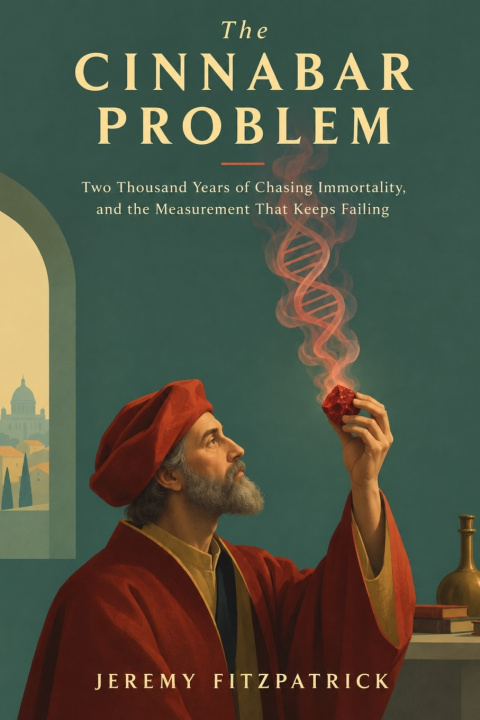
The Cinnabar Problem
Two Thousand Years of Chasing Immortality, and the Measurement That Keeps Failing
 Engleski
 46 b
46 b
 Pripremamo
 Novo
Novo
Do 30 dana za povrat

In 210 BCE the first emperor of China died on the road at Shaqiu, poisoned by the mercury compound his alchemists had prepared to make him immortal. Over the following nineteen centuries at least five more Chinese emperors died the same way. Each new emperor executed the alchemists who had killed his father. Each then found alchemists of his own.
The interesting thing about the pursuit of immortality is not that people believed in it. It is that they kept believing while watching.
The Cinnabar Problem argues that every serious attempt to defeat ageing has failed the same way, and that the failure has nothing to do with intelligence, resources or honesty. Each era substitutes something it can measure for the thing it actually wants. Reversible chemistry stood in for an incorruptible body. A dynamometer stood in for restored youth. Today a statistical model called an epigenetic clock stands in for how old you really are.
Proxies can be optimised. Push on one hard enough and it stops tracking whatever it stood for. That is Goodhart's Law, running for two thousand years inside human bodies.
What the book covers
- Brown-Séquard injecting himself with guinea pig extract in 1889, and the modern assay showing his preparation delivered four orders of magnitude too little to do anything
- Voronoff grafting monkey glands into wealthy Europeans, applauded by seven hundred surgeons in London
- Carrel's chicken heart, kept "alive" for thirty-four years by an error printed in a methods section in 1913 and unread for forty-eight
- The sirtuin drugs that bound the fluorescent tag rather than the enzyme, after $720 million had changed hands
- Why supercentenarian records collapse by up to 82% when birth certificates are checked
- Why two accredited laboratories will return different biological ages from the same blood, and why no reference standard exists to say which is right
It is not a debunking. The book argues that the antioxidant trials, universally filed as the field's great embarrassment, are its one clean success - a hypothesis tested to destruction in hundreds of thousands of people. It gives the strongest case for every position it disagrees with. And it identifies the places where the frontier is escaping the trap, including the best-designed longevity trial in the world, which is being run on people's pet dogs.
The questions the field does not ask
Between 2001 and 2014 the richest 5% of American men gained 2.34 years of life expectancy. The poorest 5% of women gained 0.04. Two weeks, across thirteen years. Anything the frontier produces will arrive into a world where a fourteen-year gap already exists and is widening.
And when Pew asked Americans whether they would want treatments to live past 120, 56% said no. Two-thirds thought most other people would say yes.
The book also turns its own instrument on itself. It proposes a single explanation for two thousand years of failure, borrowed from an idea currently fashionable in economics, offered by someone with no laboratory. That is precisely the pattern it spends thirty chapters warning about. The epilogue says so, and names what the argument is most likely to have got wrong.
It ends with something usable: eight questions to put to any claim about ageing, worked against things you can buy today.
If you remember nothing else, remember to ask what was counted.
For readers of Ben Goldacre's Bad Pharma, Stuart Ritchie's Science Fictions and David Wootton's Bad Medicine.


Informacije o knjizi
Engleski
Kategorija

Poklonite ovu knjigu još danas
To je jednostavno
1 Dodajte knjigu u košaricu i odaberite isporuku kao poklon 2 Zauzvrat ćemo vam poslati kupon 3 Knjiga dolazi na adresu poklonoprimcaDobar dan! Ja sam Libroamiko, vaš književni savjetnik.
Kako vam mogu pomoći?