
 Kontakt
 Kako kupovati
Dostava
Savjetnik za kupnju
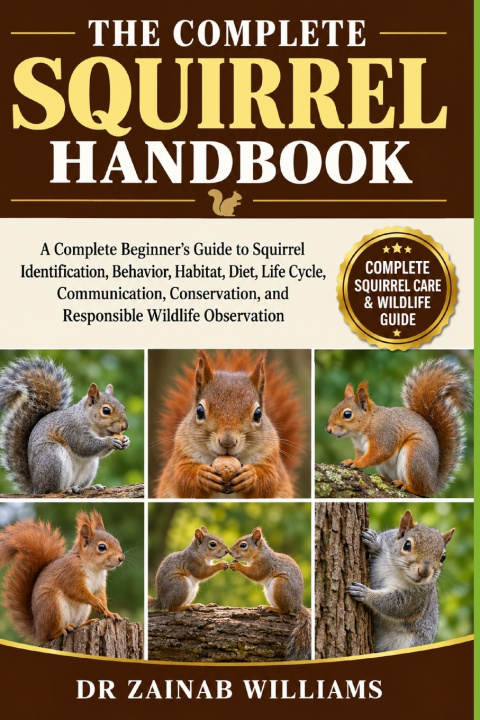
THE COMPLETE SQUIRREL HANDBOOK
A Complete Beginner's Guide to Squirrel Identification, Behavior, Habitat, Diet, Life Cycle, Communication, Conservation, and Responsible Wildlife Observation
 Engleski
 36 b
36 b
 Pripremamo
 Novo
Novo
Do 30 dana za povrat

S
quirrels are fascinating, intelligent, energetic animals whose care
can be far more demanding than many people expect. Their natural
behaviors include climbing, jumping, exploring, gnawing, digging,
foraging, hiding, and constantly investigating their surroundings. Some
species spend much of their lives in trees, while others are adapted to life on
the ground. Flying squirrels require environments that support climbing
and gliding behavior, while chipmunks and other ground-oriented species
may spend considerable time digging, exploring, and moving through
tunnels or sheltered spaces.
Because squirrels are highly active and species needs can vary greatly,
responsible care begins long before an animal enters your home or
enclosure. Good care requires preparation, patience, observation, safe
housing, appropriate nutrition, hygiene, enrichment, and a willingness to
adapt your routine to the needs of the individual animal.
This handbook is designed to help beginners, experienced caretakers,
animal lovers, hobbyists, and responsible breeders better understand
the practical responsibilities involved in squirrel care. It provides a
foundation for creating safe routines and making thoughtful decisions while
recognizing an important reality: not every squirrel species is suitable for
private ownership, and laws regarding possession, breeding, rehabilitation,
or keeping native wildlife vary by location.
A responsible caretaker does not try to force every squirrel into the same
care system. Instead, successful care begins with understanding the species,
respecting natural behavior, and providing an environment that supports
welfare rather than convenience.
1.1 Understanding the Purpose, Scope, and Practical Promise
of This Complete Squirrel Handbook
The purpose of this handbook is to provide practical guidance for understanding and caring for different types of squirrels and closely related small
animals commonly discussed alongside them, including flying squirrels,
ground squirrels, tree squirrels, red squirrels, gray squirrels, fox squirrels,
and chipmunks.
The book is not based on the assumption that every reader will keep
every species. Instead, it is designed to help readers understand the major
differences between these animals and apply care principles appropriately.
The central promise of this handbook is simple: responsible squirrel
care should be based on preparation, observation, safety, consistency, and
respect for species-specific needs.
A squirrel should never be viewed simply as a small, entertaining animal
that can be placed in a cage and occasionally fed. These animals are active,
intelligent, and often sensitive to environmental changes. A habitat that
is too small, poorly designed, dirty, unsafe, or unstimulating can create
unnecessary stress and limit normal behavior.
Practical care begins by asking the right questions:
• Is keeping this species legal where I live?
• Is the animal captive-bred, legally obtained, or in need of professional
wildlife assistance rather than private ownership?
• Can I provide enough safe space for climbing, movement, exploration,


Informacije o knjizi
Engleski

Poklonite ovu knjigu još danas
To je jednostavno
1 Dodajte knjigu u košaricu i odaberite isporuku kao poklon 2 Zauzvrat ćemo vam poslati kupon 3 Knjiga dolazi na adresu poklonoprimcaDobar dan! Ja sam Libroamiko, vaš književni savjetnik.
Kako vam mogu pomoći?