
 Kontakt
 Kako kupovati
Dostava
Savjetnik za kupnju
 Engleski
 45 b
45 b
 Novo
Novo
Do 30 dana za povrat

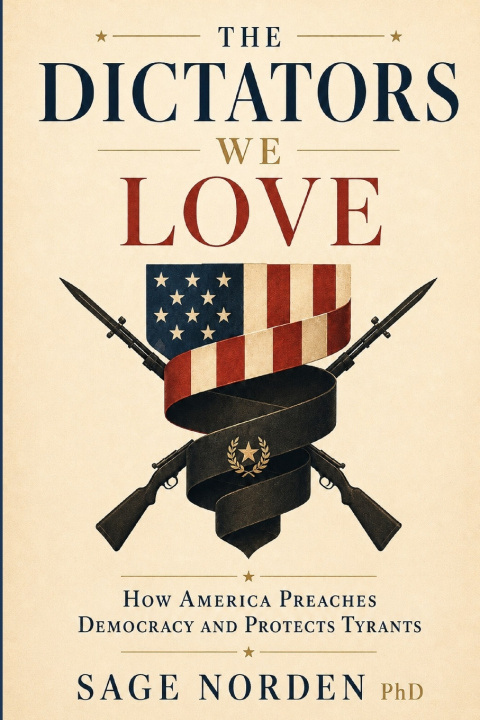
THE DICTATORS WE LOVE
How America Preaches Democracy and Protects Tyrants
America has spent generations presenting itself as the defender of democracy, liberty, human rights and government by consent.
Yet for nearly a century, Washington has repeatedly armed, financed, protected and legitimised authoritarian rulers when they served American strategic interests.
The Dictators We Love asks an uncomfortable question:
Does America really divide the world between democracies and dictatorships, or between governments that serve American interests and governments that obstruct them?
Beginning not with the Cold War, but in 1933, Sage Norden traces a recurring bargain across more than twenty governments, nine decades and six continents. From Somoza, Batista and the Shah of Iran to Pinochet, Suharto, Mobutu, Zia, Musharraf, Mubarak, Sisi and the absolute monarchies of the Gulf, the same pattern appears again and again.
A ruler becomes strategically useful.
Washington provides weapons, money, legitimacy, intelligence cooperation or diplomatic protection.
Repression is documented, condemned in principle, and accommodated in practice.
Then, when the ruler's usefulness declines, the relationship changes with remarkable speed.
But this is not a conspiracy theory, and it is not an argument that America invented dictatorship.
Drawing on declassified documents, official records, congressional material, State Department reporting and established journalism, the book distinguishes carefully between what Washington caused, what it encouraged, what it accepted, and what cannot be proved.
Each major case is tested against the same questions:
What made the ruler useful?
What did Washington know and choose not to act upon?
What did the United States receive in return?
And what happened when the political arithmetic changed?
The result is a sweeping history of American power that challenges one of the most persistent explanations for US support of authoritarian governments: that it was simply a necessary product of the Cold War.
The pattern begins before the Cold War.
And it continues long after it ends.
Along the way, The Dictators We Love examines:
• Iran and the overthrow of Mossadegh
• Guatemala, the Congo and Chile
• The Shah and America's Gulf strategy
• Pakistan under Ayub, Yahya, Zia and Musharraf
• The 1971 Bangladesh crisis
• Suharto, Mobutu and Cold War kleptocracies
• Saddam Hussein and Manuel Noriega
• Mubarak and the machinery of American military assistance
• Bahrain and the Gulf monarchies
• Sisi's Egypt
• Pakistan's contemporary military leadership
• Why human-rights restrictions so often fail to change strategic relationships
• Why authoritarian allies can sometimes offer Washington things democracies cannot
Provocative without being simplistic, critical without pretending the historical record is one-sided, The Dictators We Love is ultimately about something larger than individual presidents, generals or monarchs.
It is about a system in which values and interests can coexist without ever truly being reconciled.
And about the question America has rarely been forced to answer openly:
What if supporting dictators is not an occasional failure of American foreign policy, but one of the ways American foreign policy works?


Informacije o knjizi
Engleski
