
 Kontakt
 Kako kupovati

Dostava
Savjetnik za kupnju
 Engleski
 25 b
 Novo
Do 30 dana za povrat

The first technological revolution in human history didn't emit the hum of a server, nor the
cold flash of a liquid crystal display; instead, it coincided with the dull, dry sound of one
stone striking another. At that precise moment, in the darkness of the Paleolithic, humans
didn't just craft a tool: they split reality. Chipping flint meant imposing an abstract form,
conceived in the mind, on the inert matter of the world; it was the birth of technology and
the dawn of scientific thought. The tool was no longer an extension of the arm, but the mirror
in which humanity began to look at itself, recognize itself, and change. There would be no
biological or ontological separation between "man" and "technology"; we don't use technology,
we are technology. Today, the "remote future" of artificial intelligence and post-binary logic
is no longer an abstraction: it is the hybrid environment we inhabit. A single, urgent and
rigorous invitation: a responsibility capable of governing computational complexity before it
governs us, to remind us that progress only makes sense if humanity remains the ultimate goal,
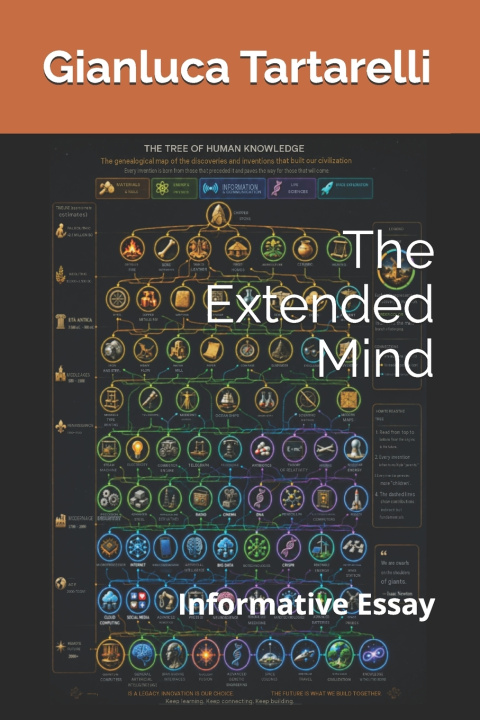
never the instrument of its own technology. I have attempted to map the tree of human knowledge,
from the Paleolithic to the hypothetical discoveries of the distant future, and trace the
network of interdependencies upon which our civilization is founded. I have taken into account
that no invention arises in isolation: the microprocessor inherits concepts from Boolean logic,
precision metallurgy, and semiconductor physics. To explore this genealogical map, simply follow
the organization of discoveries and inventions into major evolutionary branches: Materials and
Tools, Energy and Physics, Information and Communication, Life Sciences, and Space Exploration.
Each node on the map is represented by the icon of progress, a circular image connected to its
"parents", the historical prerequisites, and its "children", the inventions it made possible.
I have attempted to indicate where, within the tree of human knowledge, interruptions in the
continuity of knowledge could have occurred, both historically and hypothetically, through
possible scenarios. If some "pieces" within the tree of human knowledge were obliterated, what
could the possible ripple effects have been on the "children" nodes of progress, what possible
future scenarios?


Informacije o knjizi
Engleski

Poklonite ovu knjigu još danas
To je jednostavno
1 Dodajte knjigu u košaricu i odaberite isporuku kao poklon 2 Zauzvrat ćemo vam poslati kupon 3 Knjiga dolazi na adresu poklonoprimcaDobar dan! Ja sam Libroamiko, vaš književni savjetnik.
Kako vam mogu pomoći?