
 Kontakt
 Kako kupovati
Dostava
Savjetnik za kupnju
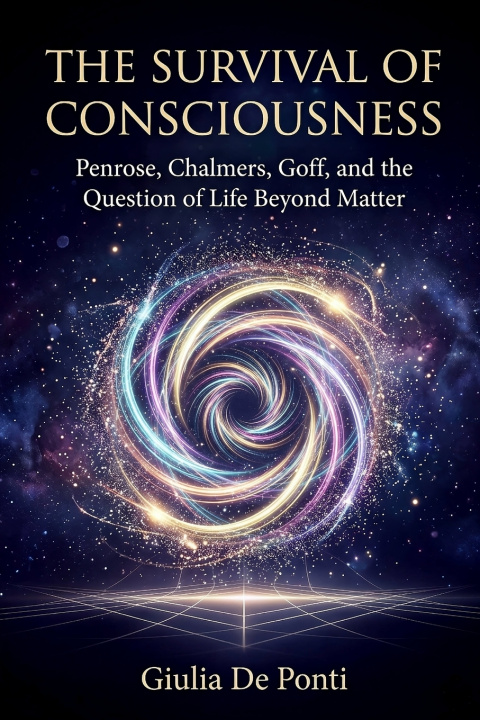
The Survival of Consciousness
Penrose, Chalmers, Goff and the Question of Life Beyond Matter
 Engleski
 36 b
36 b
Do 30 dana za povrat

The problem of consciousness has become one of the defining intellectual challenges of the twenty-first century. Despite extraordinary advances in neuroscience, artificial intelligence, cognitive science, and physics, the existence of subjective experience remains resistant to reduction. The fact that reality is experienced from within-the presence of an inner point of view-continues to raise questions that neither neuroscience nor computation have definitively resolved.
In The Survival of Consciousness, Giulia De Ponti undertakes a rigorous philosophical investigation of this unresolved frontier. Rather than treating the contemporary debate as a collection of disconnected theories, she develops a unified analysis of three of its most influential figures: Roger Penrose, David Chalmers, and Philip Goff.
Although their approaches emerge from different intellectual traditions-mathematical physics, analytic philosophy, and contemporary metaphysics-De Ponti argues that they converge upon a common conclusion of profound significance: consciousness cannot yet be adequately explained through computation, functional description, or a purely reductionist conception of matter.
This convergence is the central thesis of the book.
Penrose, Chalmers, and Goff approach consciousness from different directions, yet all three challenge the assumption that subjective experience can be fully explained by computation, brain function, or conventional materialism.
By placing these thinkers into direct philosophical dialogue, De Ponti reveals a remarkable pattern. The debate is no longer confined to neuroscience. It expands into questions concerning the foundations of physics, the limits of AI, the nature of explanation, the nature of conscious experience, and the ultimate architecture of reality.
The book examines the hard problem of consciousness, computational theories of mind, Orch OR, quantum approaches, panpsychism, the combination problem, the relationship between mind and matter, and the controversial question of whether experience can be meaningfully discussed beyond biological life.
Particular attention is given to a possibility that remains philosophically contentious yet difficult to dismiss: if subjective experience cannot be reduced to computation and occupies a more fundamental place in reality than traditional materialism allows, then prevailing assumptions about mind, personal identity, and survival may require substantial reconsideration.
The discussion is conducted with intellectual discipline and careful attention to contemporary scholarship. The book neither embraces dogmatism nor accepts premature closure. It acknowledges the extraordinary achievements of modern science while insisting that important explanatory questions remain open.
Artificial intelligence provides a striking example. Machines can process information, generate language, solve problems, and imitate understanding, yet whether such abilities are accompanied by genuine subjective awareness remains unresolved. This distinction, central to Penrose's work, is one of the book's recurring themes.
More than a survey of theories, this book invites readers to reconsider whether consciousness is merely a product of physical processes or a clue to deeper structures of reality.
In doing so, Giulia De Ponti contributes to one of the most important intellectual conversations of our age: the effort to understand what consciousness is, why it exists, and whether the reality of experience points beyond the explanatory limits of conventional materialism.
For readers interested in philosophy of mind, consciousness studies, ontology, metaphysics, artificial intelligence, neuroscience, quantum theory, and the enduring question of whether mind is ultimately reducible to matter, this book offers a serious and ambitious contribution to one of the deepest debates in contemporary thought.


Informacije o knjizi
Engleski

Poklonite ovu knjigu još danas
To je jednostavno
1 Dodajte knjigu u košaricu i odaberite isporuku kao poklon 2 Zauzvrat ćemo vam poslati kupon 3 Knjiga dolazi na adresu poklonoprimcaDobar dan! Ja sam Libroamiko, vaš književni savjetnik.
Kako vam mogu pomoći?