
 Kontakt
 Kako kupovati
Dostava
Savjetnik za kupnju
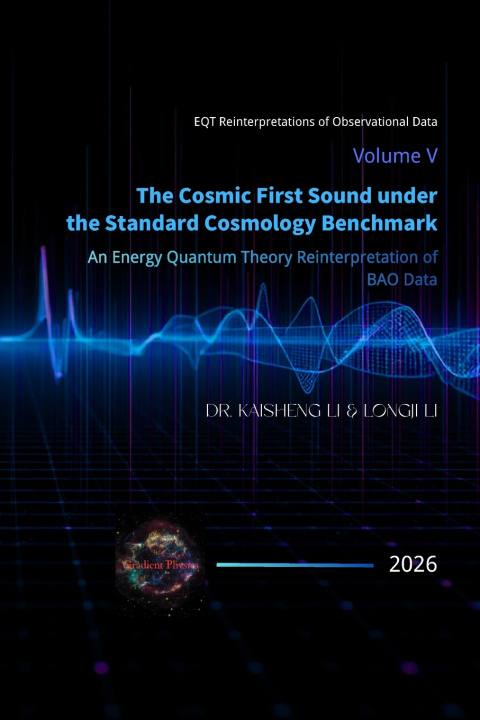
Volume V
The Cosmic First Sound under the Standard Cosmology Benchmark: An Energy Quantum Theory Reinterpretation of BAO Data
 Engleski
 69 b
69 b
 Pripremamo
 Novo
Novo
Do 30 dana za povrat

This volume is part of the series EQT Reinterpretations of Observational Data. It examines baryon acoustic oscillations (BAO) from the perspective of Energy Quantum Theory (EQT), treating standard cosmology and the sound-horizon description as effective benchmarks for the observed acoustic scale.
The book does not replace the standard BAO account, where the BAO scale is the frozen remnant of acoustic waves in the pre-recombination photon-baryon plasma, calibrated by CMB and galaxy surveys. Accepting this, the volume addresses a narrower question: can the same data be reorganized within EQT as the excitation, propagation, and freezing of low-frequency gravitational density perturbations, yielding diagnostic structure and falsifiable predictions beyond the sound horizon?
The argument proceeds in a disciplined sequence:
Reformulation: BAO is reformulated as the frozen structure of a perturbation in the low-frequency gravitational component of the energy-quantum density field.
Co-evolutionary Transient: The observed acoustic scale is interpreted as a co-evolutionary transient formed by the interaction between surveys and the pre-recombination source.
Detectability Criteria: The book develops criteria-frequency matching, amplitude threshold/freezing, three-state decomposition, and detection-matrix positioning-to clarify what surveys can record, what remains excluded, and when a primordial structure becomes an empirical BAO signal.
A distinctive feature is treating BAO as a cross-frequency coupling event. The high-frequency photon-baryon plasma before recombination acts as a driving field that excites low-frequency gravitational density perturbations through a constrained coupling channel. The resulting structure propagates, reaches the drag epoch, and freezes into a characteristic comoving scale. Thus, the "cosmic first sound" becomes a disciplined reinterpretation of the first large-scale collective perturbation read by present-day surveys.
EQT offers a structured reading of the BAO scale. While retaining the sound horizon as the standard description, it reinterprets the acoustic peak as a three-state readout involving free-state radiation, bound-state acoustic structure, and condensed-state gravitational configuration. EQT provides a dynamical form for the sound speed and a state-based freezing interpretation, while borrowing the numerical value of the standard relativistic-fluid sound speed as part of the benchmark.
The book is methodologically committed to falsifiability through specific failure conditions:
Frequency: Fails if frequency matching does not distinguish driving and response bands.
Threshold: Fails if the freezing condition cannot be related to the observed acoustic scale.
State: Fails if three-state decomposition yields no stable residual structure across CMB and galaxy-survey data.
Evidence: Fails if proposed residual correlations are indistinguishable from standard cosmological uncertainties.
Combining BAO observations, CMB/galaxy surveys, standard cosmology, detector-response analysis, and EQT, this volume offers a cautious framework for re-reading cosmology's precise standard ruler. It is intended for readers interested in foundational physics, cosmology, large-scale structure, observational methodology, and reinterpreting existing measurements without abandoning standard cosmology's success.


Informacije o knjizi
Engleski

Poklonite ovu knjigu još danas
To je jednostavno
1 Dodajte knjigu u košaricu i odaberite isporuku kao poklon 2 Zauzvrat ćemo vam poslati kupon 3 Knjiga dolazi na adresu poklonoprimcaDobar dan! Ja sam Libroamiko, vaš književni savjetnik.
Kako vam mogu pomoći?