
 Kontakt
 Kako kupovati
Dostava
Savjetnik za kupnju
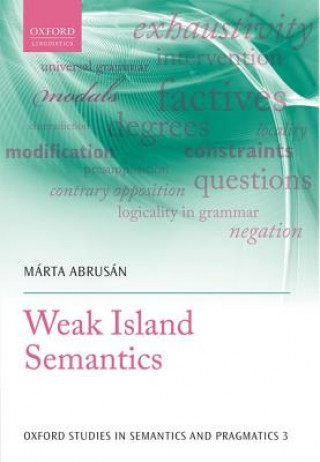
Weak Island Semantics
 Engleski
 166 b
166 b
30 dana za povrat kupljenih proizvoda
Kupci su kupili i


This book presents a novel semantic account of weak, or selective, islands. Weak islands are configurations that block the displacement of certain elements in a sentence. Examples of island violations with acceptable counterexamples include '#How much wine haven't you drunk?' (but 'Which girl haven't you introduced to Mary?'), '#How does John regret that he danced at the party?' (but 'Who does John regret that he invited to the party?') or '#How much wine do you know whether you will produce?' (but 'Which glass of wine do you know whether you'll poison?'). For forty years or more, explanations of the unacceptability of these island constructions have been syntactic. Syntactic accounts have also provided some of the key empirical motivation for Chomsky's claim that universal grammar (UG) contains language independent abstract syntactic constraints. But syntactic accounts, however subtle, fail to explain why many weak island violations are made almost acceptable by modals and attitude verbs, as in 'How much wine aren't you allowed to drink?'; 'How fast do you hope Lewis didn't drive?'; or 'How does Romeo regret he was allowed to go to the party?' Dr Abrusan considers which contexts and expressions create - or are sensitive to - weak island violations, and examines the factors that go some way to curing them. She puts forward a semantic analysis to account for the unacceptability of violations of negative, presuppositional, quantificational and wh-islands. She explains why grammaticality violations can be obviated by certain modal expressions, and why and how far the grammaticality judgments of speakers depend on the context of the utterance. The book argues that there is no need to assume abstract syntactic rules in order to derive these facts; rather, they can be made to follow from independent semantic principles. If correct, this work has a fundamental consequence for the field of linguistics in general: it removes some of the most important reasons for postulating abstract syntactic rules as part of UG, and hence weakens the arguments for postulating a module of UG.


Informacije o knjizi
Engleski

Poklonite ovu knjigu još danas
To je jednostavno
1 Dodajte knjigu u košaricu i odaberite isporuku kao poklon 2 Zauzvrat ćemo vam poslati kupon 3 Knjiga dolazi na adresu poklonoprimcaMoglo bi vas zanimati i







 /
/
 Meki uvez
 24.10
€
24.10
€

 /
Meki uvez
13.36
€
/
Meki uvez
13.36
€




 /
Meki uvez
23.08
€
/
Meki uvez
23.08
€


 /
Tvrdi uvez
98.94
€
/
Tvrdi uvez
98.94
€


Dobar dan! Ja sam Libroamiko, vaš književni savjetnik.
Kako vam mogu pomoći?