
 Kontakt
 Kako kupovati
Dostava
Savjetnik za kupnju
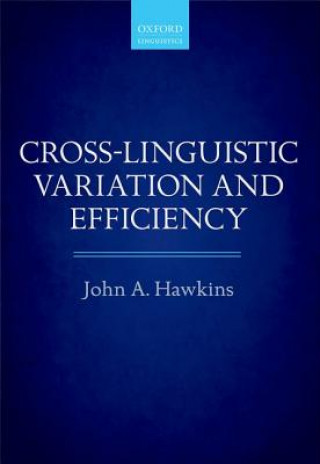
Cross-Linguistic Variation and Efficiency
 Engleski
 186 b
186 b
Do 30 dana za povrat
Kupci su kupili i
















 /
/
 Meki uvez
 17.95
€
17.95
€


 /
Meki uvez
14.50
€
/
Meki uvez
14.50
€



In this book John A. Hawkins argues that major patterns of variation across languages are structured by general principles of efficiency in language use and communication. Evidence for these comes from languages permitting structural options from which selections are made in performance, e.g. between competing word orders and between relative clauses with a resumptive pronoun versus a gap. The preferences and patterns of performance within languages are reflected, he shows, in the fixed conventions and variation patterns across grammars, leading to a 'Performance-Grammar Correspondence Hypothesis'. Hawkins extends and updates the general theory that he laid out in Efficiency and Complexity in Grammars (OUP 2004): new areas of grammar and performance are discussed, new research findings are incorporated that test his earlier predictions, and new advances in the contributing fields of language processing, linguistic theory, historical linguistics, and typology are addressed. This efficiency approach to variation has far-reaching theoretical consequences relevant to many current issues in the language sciences. These include the notion of ease of processing and how to measure it, the role of processing in language change, the nature of language universals and their explanation, the theory of complexity, the relative strength of competing and cooperating principles, and the proper definition of fundamental grammatical notions such as 'dependency'. The book also offers a new typology of VO and OV languages and their correlating properties seen from this perspective, and a new typology of the noun phrase and of argument structure.


Informacije o knjizi
Engleski

Poklonite ovu knjigu još danas
To je jednostavno
1 Dodajte knjigu u košaricu i odaberite isporuku kao poklon 2 Zauzvrat ćemo vam poslati kupon 3 Knjiga dolazi na adresu poklonoprimcaMoglo bi vas zanimati i






 /
Tvrdi uvez
29.82
€
/
Tvrdi uvez
29.82
€
 /
Meki uvez
46.45
€
/
Meki uvez
46.45
€







 /
Tvrdi uvez
82.88
€
/
Tvrdi uvez
82.88
€







Dobar dan! Ja sam Libroamiko, vaš književni savjetnik.
Kako vam mogu pomoći?